

We run advertisements to support our journalism. Please click here to see our advertising principles, which protect our editorial independence.
If you’d like to advertise on the newsletter, please email me — tim@understandingai.org. I can send you a rate card and answer any questions you might have.
As I write this in August 2026, Understanding AI has more than 290,000 readers. But back in March, when I last surveyed readers, we had around 190,000 readers. More than 1,000 people responded.
The main takeaway from the survey was that advertising on Understanding AI is a great way to reach influential and tech-savvy readers:
25% of respondents were engineers, scientists, researchers, IT professionals, or others doing technical work.
Another 15% are founders, executives, or managers.
19% of respondents say they have control over technology budgets at their companies, while another 25% say they recommend or evaluate technology for their companies.
Some respondents control or influence substantial budgets: 3% say they control or influence budgets larger than $5 million, while another 4% control or influence budgets between $1 million and $5 million.
Read on for detailed results from the March survey.
1. A lot of readers found us via Substack
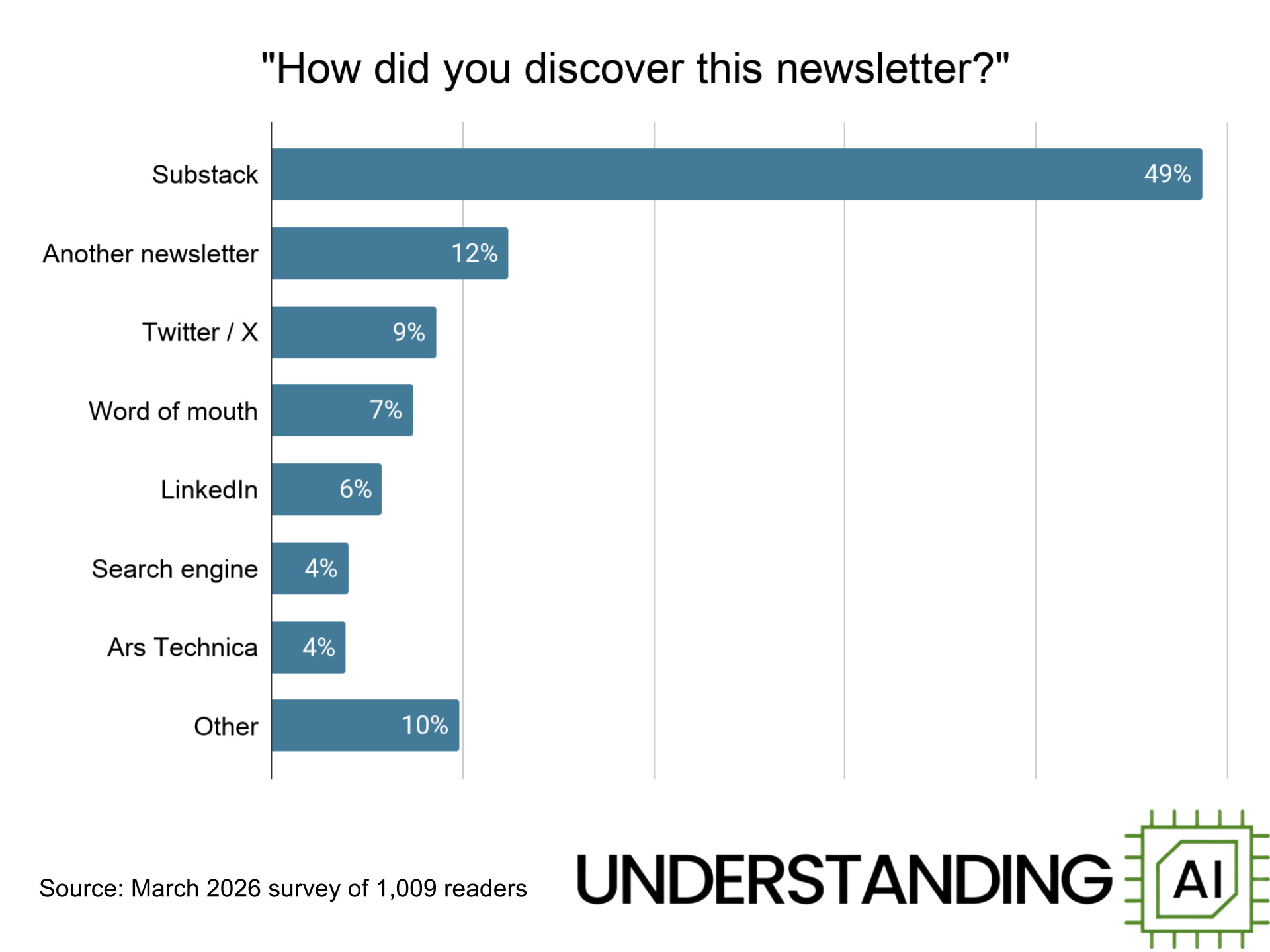
How do people find Understanding AI? Nearly half of respondents say they found us thanks to a recommendation from Substack itself. Other Substack-based newsletters — including Nate Silver, Derek Thompson, Sayash Kapoor and Arvind Naryanan, Noah Smith, Matt Yglesias, and Joey Politano — have each driven thousands of signups. An interview with Ben Thompson (who isn’t on Substack) drove hundreds of signups in 2024. My former employer, Ars Technica, accounts for about 4% of respondents.
Two social media sites — Twitter and LinkedIn — accounted for 15% of our respondents. Search engines, word of mouth, and a long tail of other sources round out the list.
2. Readers care about LLMs, technology deep dives, and AI infrastructure
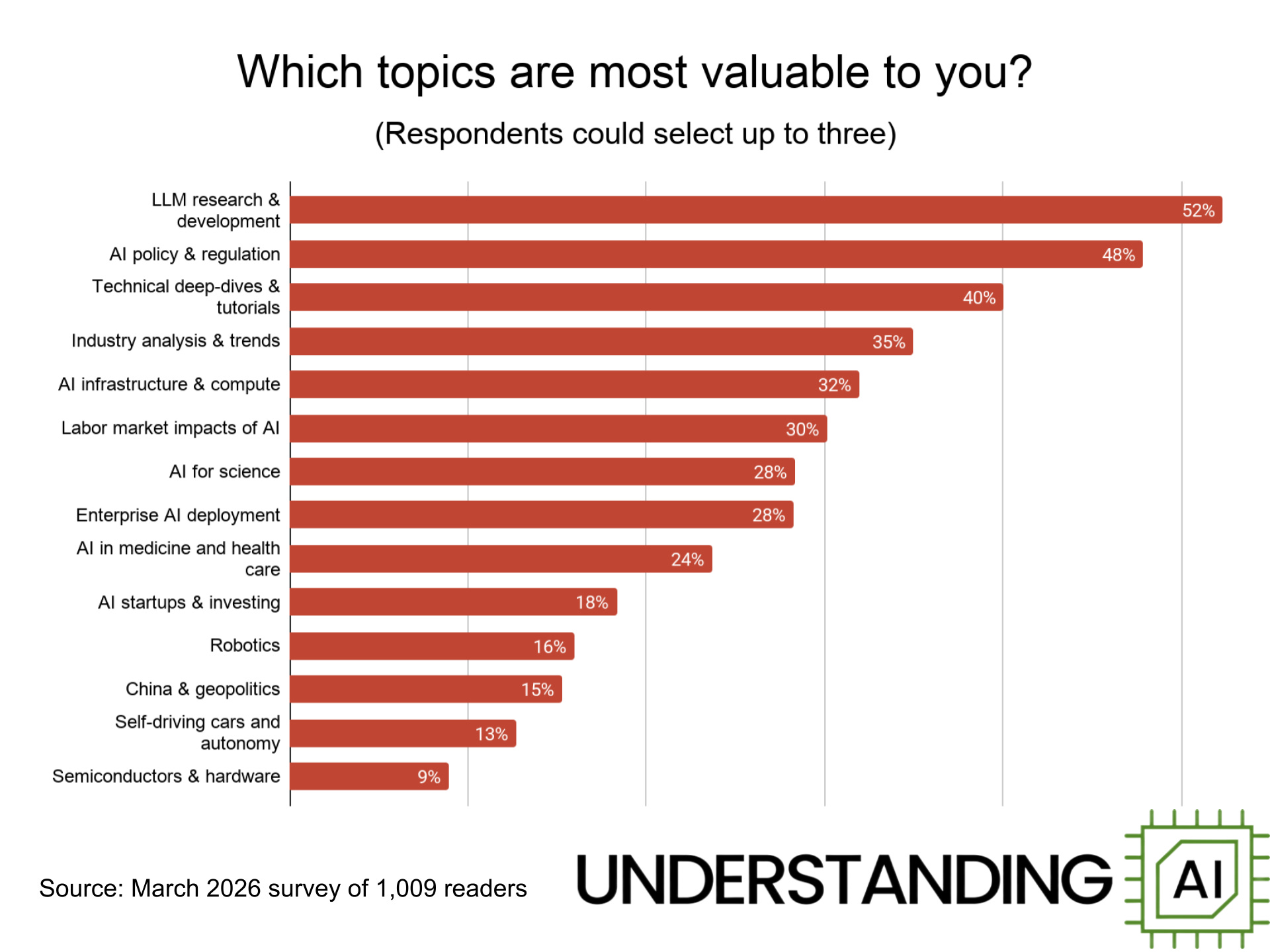
What do readers want to read about? This chart shows the topics readers say are most likely to hold their attention. Unsurprisingly, LLMs top the list, with technical deep dives, industry analysis, and AI infrastructure close behind. Readers are also interested in “softer” topics such as AI policy and the impact of AI on the labor market.
At the opposite end of the spectrum, readers continue to have fairly low interest in self-driving cars, robotics, and the semiconductor industry. I’ll be honest — we’re not going to give too much weight to reader preferences here. Not only is self-driving an important industry in its own right, I believe studying it can provide insights into the problems facing frontier model developers today. And we hope our forthcoming series on robots will convince readers that robotics is an interesting topic.
3. Our readers are technically sophisticated
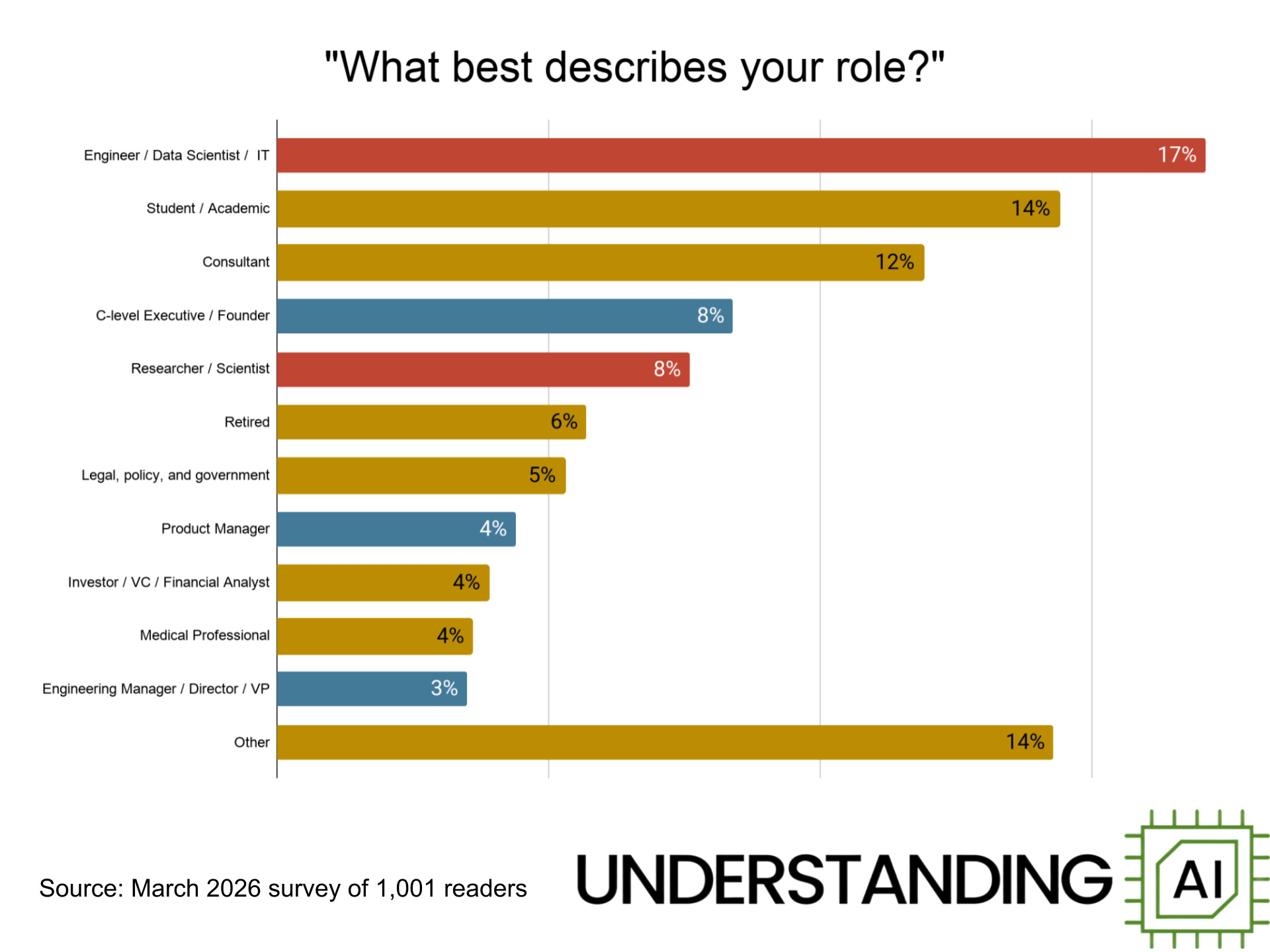
A wide range of people read Understanding AI, from students to retirees to doctors and lawyers. But I was particularly happy to see strong representation from engineers, entrepreneurs, and corporate executives. In the chart, I’ve colored engineers and scientists red, while manager and executive are blue.
These red and blue bars represent the folks actually building AI technology. I love having these folks as readers because these are the folks who will complain if we get the technical details wrong. I think they will be also be appealing to advertisers, since they often hold the purse strings of corporate IT spending.
4. At least 27% work in technology, research, or academia
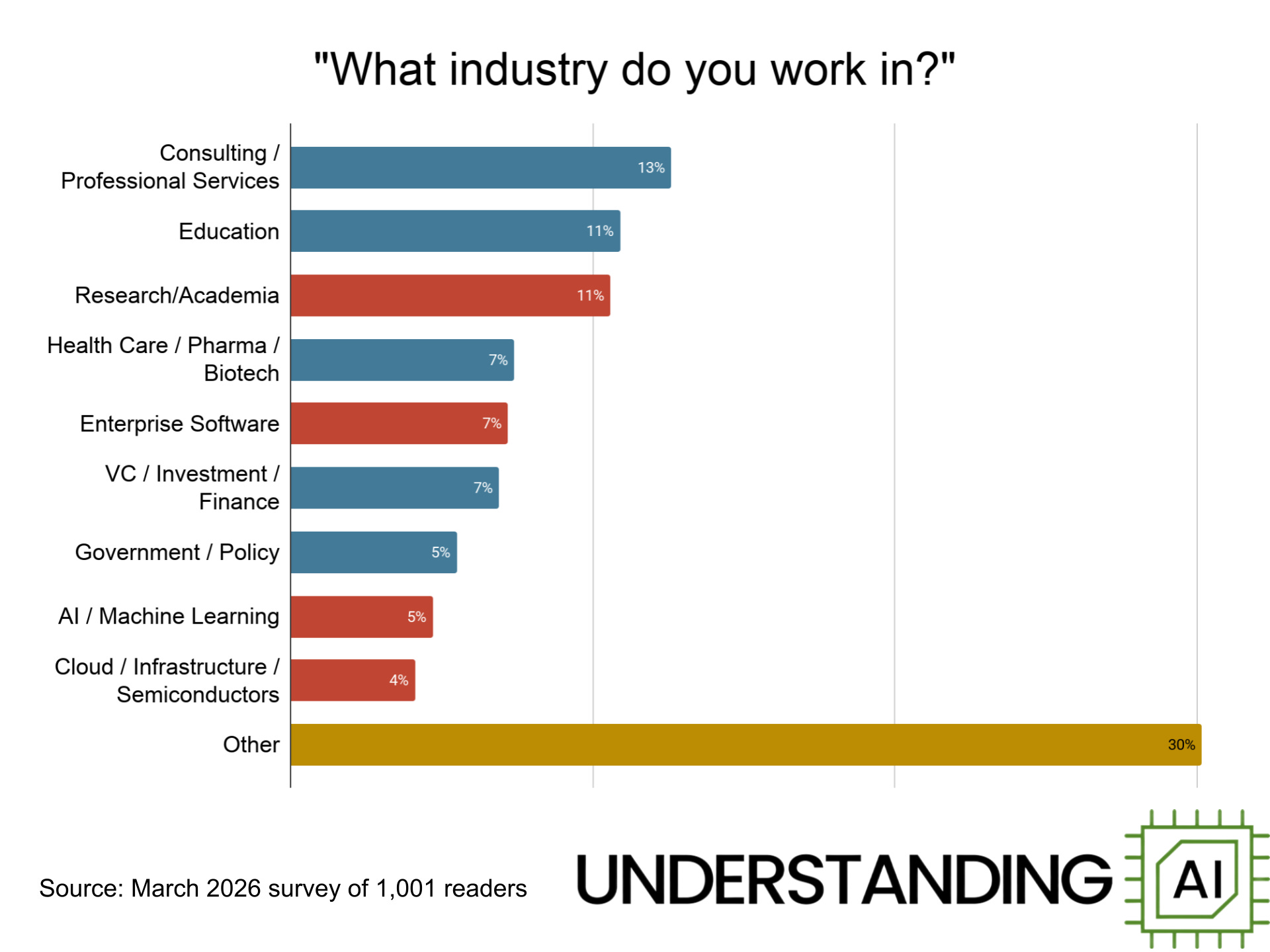
We have readers from a diverse range of industries. Some work directly on AI, either as academic researchers or at companies building AI products. But we also have a lot of readers in other industries, including education, health care, and the investment world.
5. 27% are actively involved in AI-related research or development
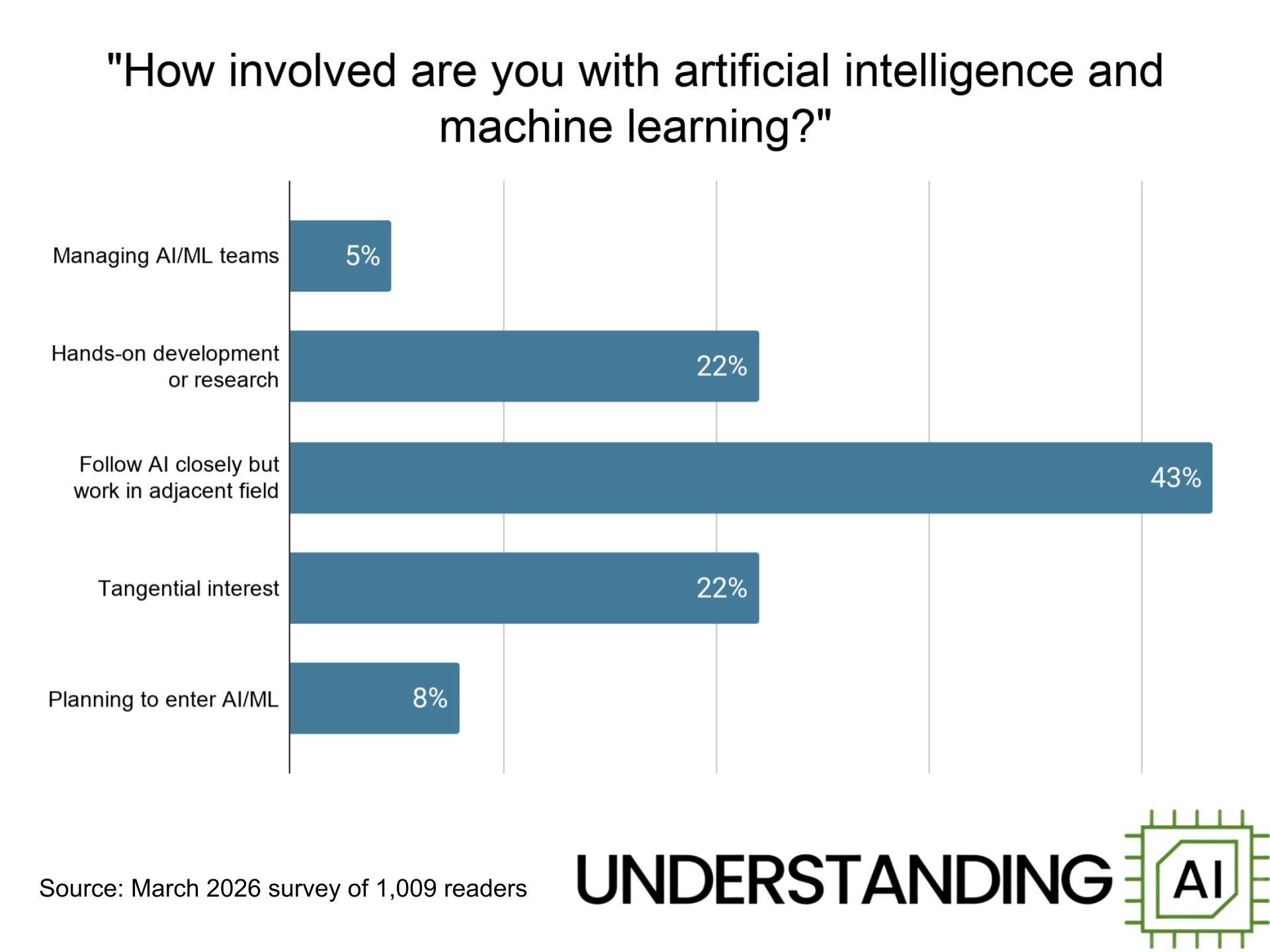
A significant minority of respondents — 27% — say they are actively involved in developing and deploying AI systems.
6. Readers have a lot of influence over corporate IT spending
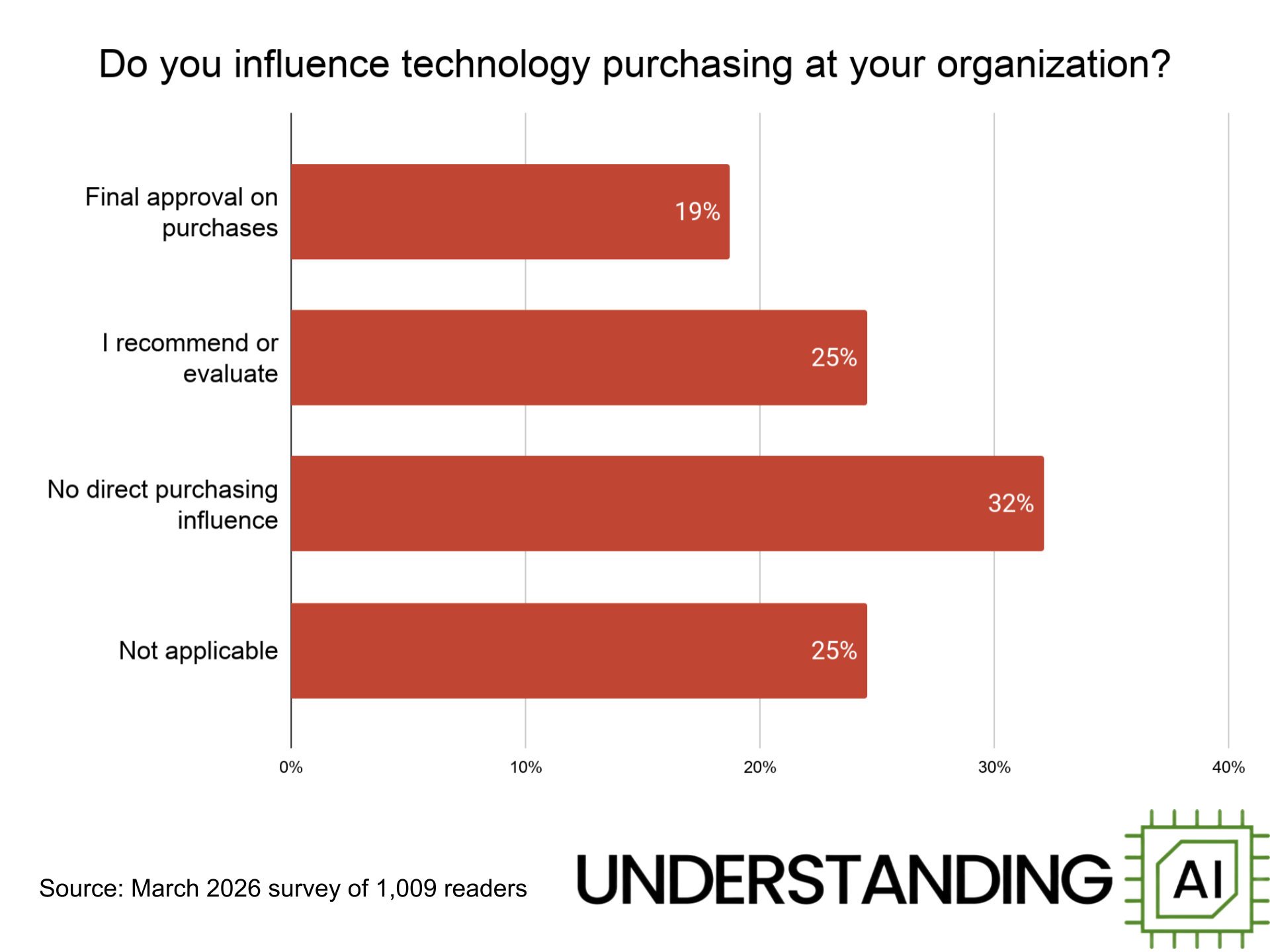
Our readers exercise a lot of influence over technology spending at their companies. Nearly 20% of respondents say they have final authority to approve technology purchases. Another 25% are involved in recommending or evaluating technology products.
7. Readers control budgets as high as $5 million
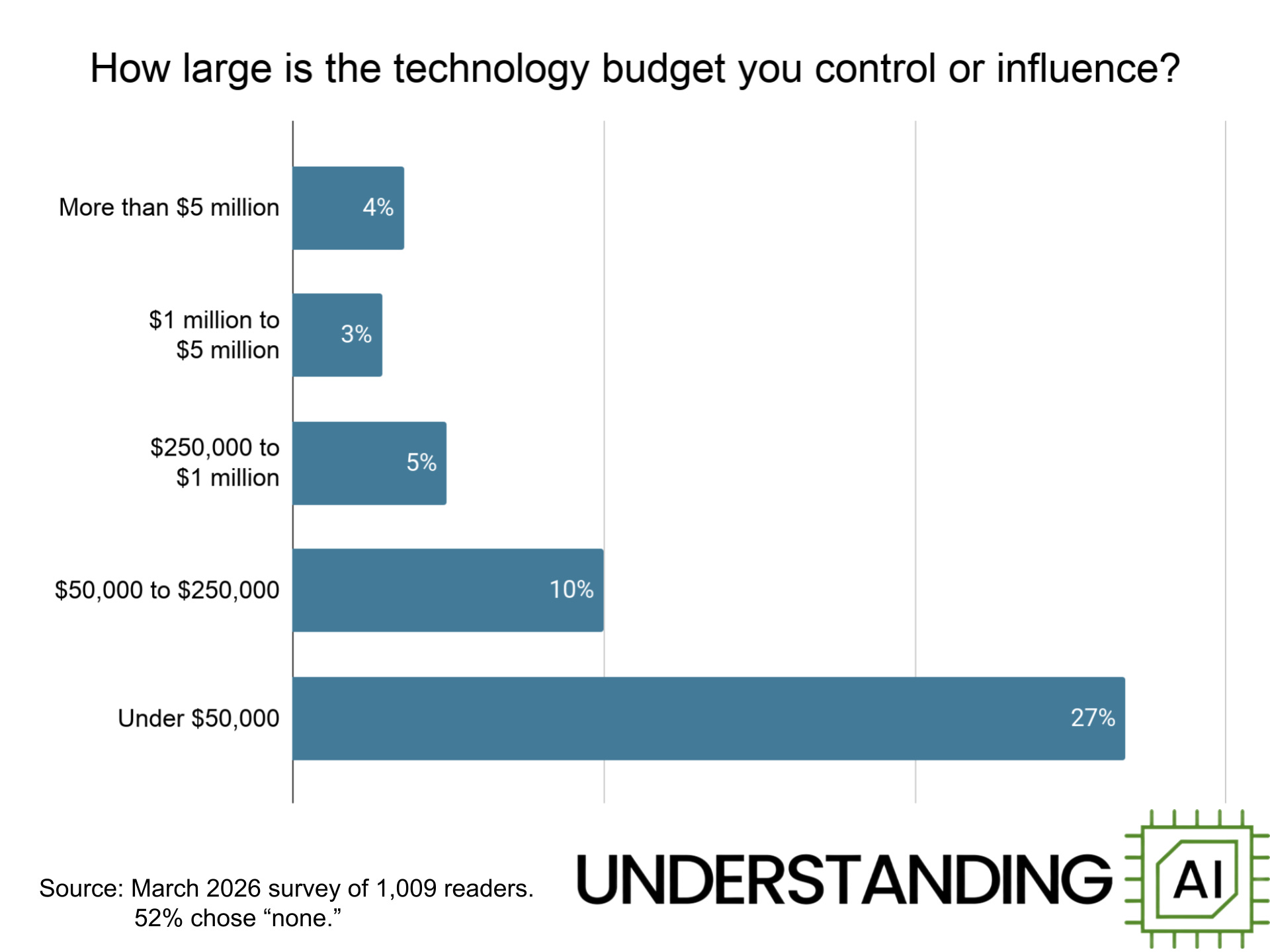
About 7% of respondents say they control or influence more than $1 million in spending each year — including 4% who say they control or influence more than $5 million in spending. Another 15% influence budgets between $50,000 and $1 million.
Conclusion
If you represent a company interested in advertising on Understanding AI, please get in touch by email: tim@understandingai.org
I like the way you’re thinking about the trust side of this.
Ads are not automatically a problem.
The problem is when readers can no longer tell whether the publication is serving them or serving the sponsor.
Keeping paid readers ad-free makes sense.
But the bigger move is drawing a clear line around who can advertise, especially in a space like AI where many sponsors could also become subjects of coverage.
That boundary is what protects the thing advertisers are really buying in the first place:
reader trust.
thought this might be of interest to you...
https://www.beehiiv.com/blog/the-state-of-paid-newsletters-2026