

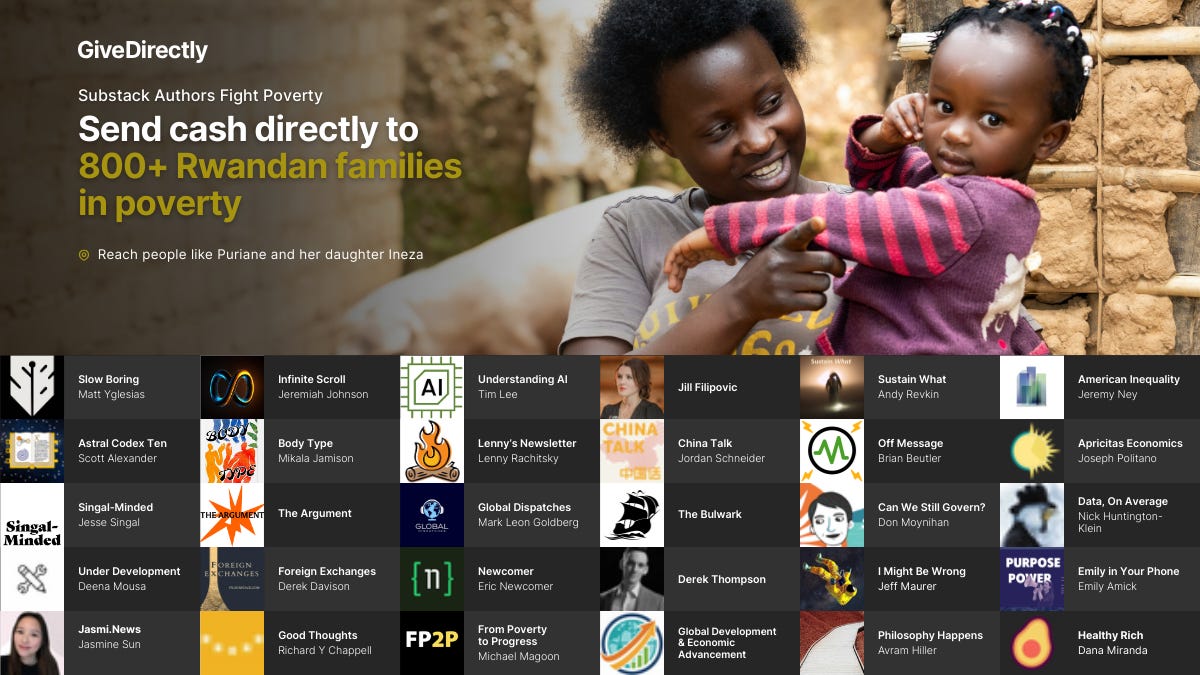
It’s Giving Tuesday, and Matt Yglesias—my former colleague at Vox and now author of the excellent newsletter Slow Boring—has organized a consortium of Substack writers to raise money for GiveDirectly. This non-profit organization does exactly what it sounds like: give cash directly to poor people in low-income countries.
This year the group is aiming to raise at least $1 million to help people in rural Rwanda. I’m hoping that Understanding AI readers will contribute at least $20,000 to that total—please use this special link if you’d like to be counted as an Understanding AI reader.
If donations from readers total at least $20,000, my wife and I will donate an additional $10,000.
There are lots of charities out there that try to help poor people in various ways, such as delivering food, building infrastructure, or providing education and health care. Such efforts are praiseworthy, but it can sometimes be difficult to tell how much good they are doing — or whether it would be better to spend the money on something else.
The insight of GiveDirectly is that we can just give cash directly to people in need and let them decide how to spend it. Here’s how Matt describes it:
The organization works in low-income countries, including Kenya, Malawi, Mozambique, Rwanda, and Uganda, to identify villages where a large majority of the population is very poor by global standards. They then enroll the entire population of the village in the program, using mobile banking to transfer approximately $1,100 to each household in town.
This transfer boosts recipients’ short-term living standards, minimizes logistical complications and perverse incentives, and, optimistically, is a kind of shot in the arm to the local economy. After all, one problem with being desperately poor and also surrounded by other desperately poor people is that even when you have useful goods or services to sell, no one can afford to buy them.
Some recipients spend the money on immediate needs like food or medicine. Others use the money in ways that have longer-term benefits, such as buying equipment, starting a business, or sending children to school. In either case, the money will go a lot farther in a Rwanda than it would here in a rich country like the United States.
Understanding AI has more than 100,000 readers, and 98 percent of you are on the “free” list. If you’ve found my newsletter useful, a donation to GiveDirectly would be a great way to say thanks.
Wonderful, Tim -- just donated $100 ... and pleased to be part of your 2%. Let us know if the $20,000 threshold is reached and keep writing the good write!
I feel for the world as a whole of course in a perfect situation I'd be happy to contribute,but quite honestly I'm homeless right here in the rich country of America. To no reasons of my makings. Rent is to high pay to low and prices for everything are out of control.So I so much would love to help but living in a van down by the river it's tough. Hope you reach your mark I'll try after Holidays