


Last October, Waymo had begun testing its freeway capability, but the company had not yet rolled it out to all vehicles. On a rainy Saturday morning, a routing error caused a Waymo vehicle not qualified for freeway operation to drive onto US 101 just south of the Golden Gate Bridge. Unable to continue, the vehicle stopped in the right lane about 30 meters past the entrance ramp (there was no shoulder).
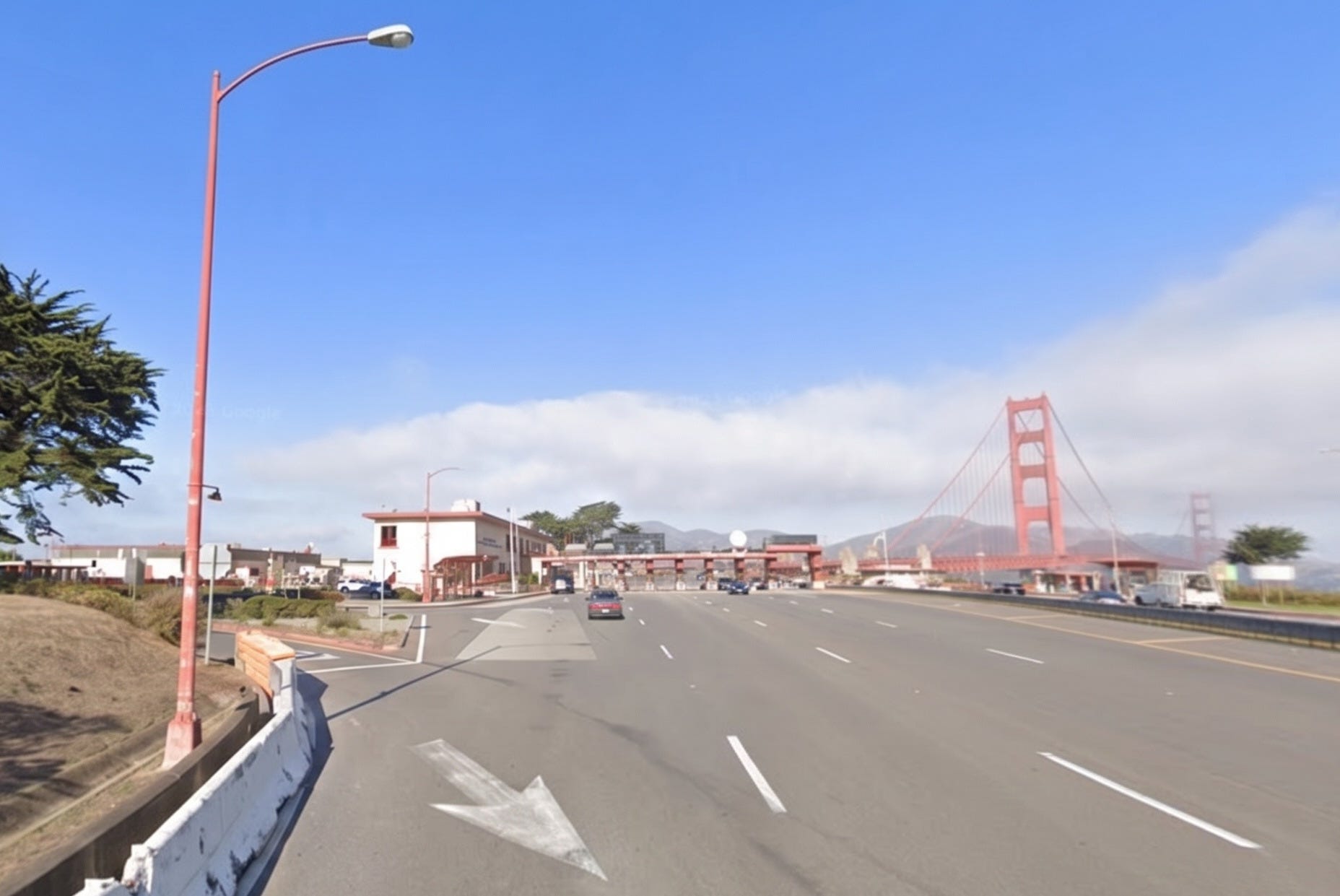
For the next two minutes and 18 seconds, nothing bad happened. Four vehicles entered US 101 South and routed around the stopped Waymo without incident, according to a Waymo crash report.
But then a white Honda SUV entered the freeway and tried to drive around the Waymo. Unfortunately, the SUV collided with a pickup truck that was driving by in the next lane. The pickup truck lost control, swerved right, crashed through a steel railing, and fell more than 15 feet onto a road below.
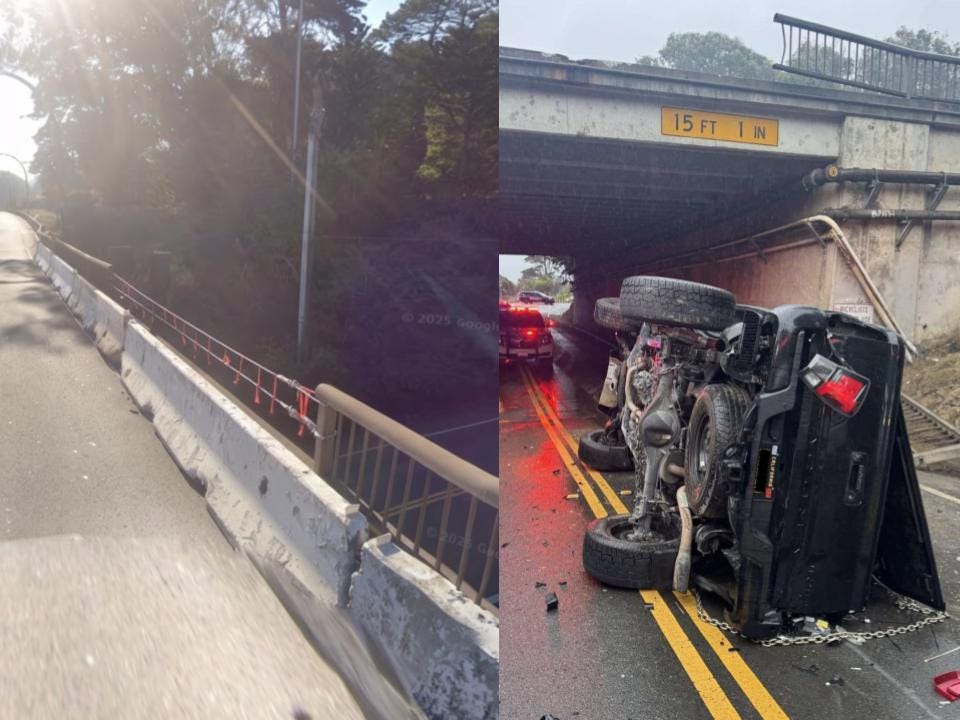
Two passengers in the pickup truck complained of back pain to the police but declined to be taken to the hospital.
This was one of the most dramatic crashes Waymo has reported to federal regulators in recent months.
For this story, one of us (Kai) looked through dozens of crash reports Waymo submitted to the National Highway Traffic Safety Administration between August 15, 2025 and March 16, 2026. He focused on 78 crashes involving driverless Waymos serious enough to cause an injury or an airbag deployment.
Waymo likely drove more than 100 million miles during this time period,1 so it’s not surprising that Waymo was involved in dozens of crashes. But it’s striking how many of the crashes involved serious mistakes by other drivers.
When Waymo’s vehicles did make mistakes, they were almost always mistakes of excessive caution. That was certainly true of that October incident where a Waymo stopped on the freeway near the Golden Gate Bridge. And as we’ll see, it’s true of most of the other incidents where a Waymo vehicle’s actions may have contributed to a crash.
Waymo’s overall safety record continues to be quite strong. Last month, the company released fresh data about Waymo’s safety record through the end of 2025. Waymo estimates that compared to human drivers in the same cities, its vehicles get into 82% fewer crashes that cause injuries, 83% fewer crashes that trigger airbags, and 92% fewer crashes that injure pedestrians. Our review of recent Waymo crashes — which seem to be overwhelmingly caused by mistakes by human drivers — seems consistent with Waymo’s safety claims.
Waymo’s safety record since August
It seems unlikely that Waymo could have prevented most of the 78 serious crashes the company reported between mid-August 2025 and mid-March 2026.
48 crashes — more than half — happened when another vehicle hit a Waymo from behind. This included 24 crashes while the Waymo was stopped at a stop sign or stoplight, 13 rear-end crashes into a moving Waymo, and six crashes where a Waymo got rear-ended while yielding to a pedestrian or another vehicle.2 It also included four crashes after a Waymo stopped to drop off or pick up a passenger and one crash where a car moving at a “high rate of speed” crashed into a line of stopped cars that included a Waymo.
There were another 12 incidents where another vehicle hit a stopped Waymo from other directions. This included two in pickup or drop-off scenarios, and two where the Waymo was side-swiped by another car on a narrow street. One driver appears to have hit a Waymo intentionally. According to Waymo’s report, an SUV cut a Waymo off. When the Waymo stopped, the SUV backed into the Waymo, pulled forward, and backed into the Waymo again.
A further 12 cases involved someone crashing into a moving Waymo — three where another car or bicycle T-boned a Waymo at an intersection, three where another car made a left turn in the Waymo’s path, four where another vehicle going the other direction crossed into the Waymo’s lane, and two where other vehicles collided and one of them subsequently struck a Waymo.
There were two crashes where the Waymo didn’t get hit at all. One was the dramatic story at the start of this article where a pickup truck fell off a bridge. The other was much less dramatic: a vehicle two spots behind a Waymo got rear-ended by yet another vehicle.
That leaves four other crashes where fault seems mixed or unclear:
In Scottsdale, Arizona in November, a teenager exited a moving Waymo. Waymo told the Washington Post that the Waymo was traveling 35 miles per hour when the teen opened the door. The Waymo slammed on the brakes, but it still ran over the teen’s right foot at four miles per hour, according to Waymo’s crash report. It stayed on his foot for more than eight minutes. Eventually, emergency services arrived and lifted the vehicle to release the teen, who was taken to the hospital. His foot was not broken.
In Palo Alto, California in December, a Waymo was taking a right turn. It stopped “within the crosswalk to yield to a cyclist” who was approaching from the near sidewalk. The cyclist hit the right side of the Waymo, fell to the ground, and was taken to the hospital with minor injuries. The cyclist entered the crosswalk against a red light. It’s unclear why the Waymo stopped here; it’s possible the collision could have been avoided if the Waymo had continued moving.
In December, a Waymo in Phoenix braked and moved into the right lane after a dog entered the road. Another vehicle then rear-ended the Waymo. From the description of the crash, it’s possible that the Waymo braked suddenly, surprising the other driver.
Finally, in Santa Monica, California in January, a Waymo hit a child near an elementary school. Waymo says that it braked from 17 mph to 6 mph — faster than a human would have been able to stop. But it’s unclear whether the Waymo should have been more cautious. The crash occurred during the school’s drop-off time. And while the Waymo was under the 25 mph speed limit, the collision occurred just 40 feet north of a school zone where the speed limit was 15 mph.
Waymo’s biggest struggles involve safe stopping
That last incident is the only one where a moving Waymo crashed into another vehicle or pedestrian and the Waymo could plausibly bear some responsibility. The other potential Waymo mistakes all involved a Waymo being too cautious — stopping where it shouldn’t have or stopping for too long.
One example is the freeway crash at the beginning of this article. Drivers are not supposed to stop on the freeway, and they are especially not supposed to stop right after an entrance ramp or at a spot where there’s no shoulder.
This isn’t the only time a Waymo has abruptly stopped after reaching the limits of its operating domain. In early March, a Miami Redditor wrote that because of construction, the Waymo they were riding in “hit the edge of its Miami geofence and abruptly slammed on its brakes, diagonally blocking the highway on-ramp.” Thankfully, no crash occurred, but the Waymo remained on the highway on-ramp for the following 45 minutes until it could be towed, even as several cars had to “swerve” to avoid the car.
A Waymo spokesperson told the Miami New Times that “while this event did not meet our standard for operational excellence, we learn quickly from such occurrences to continuously improve.”
Another serious Waymo mistake involved that teenager in Arizona. It’s not clear if Waymo could have avoided running over his foot — exiting a moving vehicle is inherently dangerous. But having run over his foot, the vehicle definitely should not have stayed in place for more than eight minutes.
Autonomous vehicle companies struggle with this because moving can also have serious consequences. Back in 2023, Waymo’s main competitor was a GM subsidiary called Cruise. In a horrifying incident in San Francisco, a non-Cruise vehicle struck a woman and threw her in front of a Cruise vehicle. The Cruise vehicle slammed on the brakes, but she wound up underneath the car. After stopping, the Cruise vehicle pulled over to the side of the road, dragging the woman underneath the vehicle for about 20 feet.
That was a serious mistake! Waymo’s engineers probably studied that incident closely and may have changed Waymo’s software to be more cautious about moving following a crash. And most of the time, that’s the right instinct. But it’s obviously not the right response when a teenager’s foot is trapped under one of the wheels.
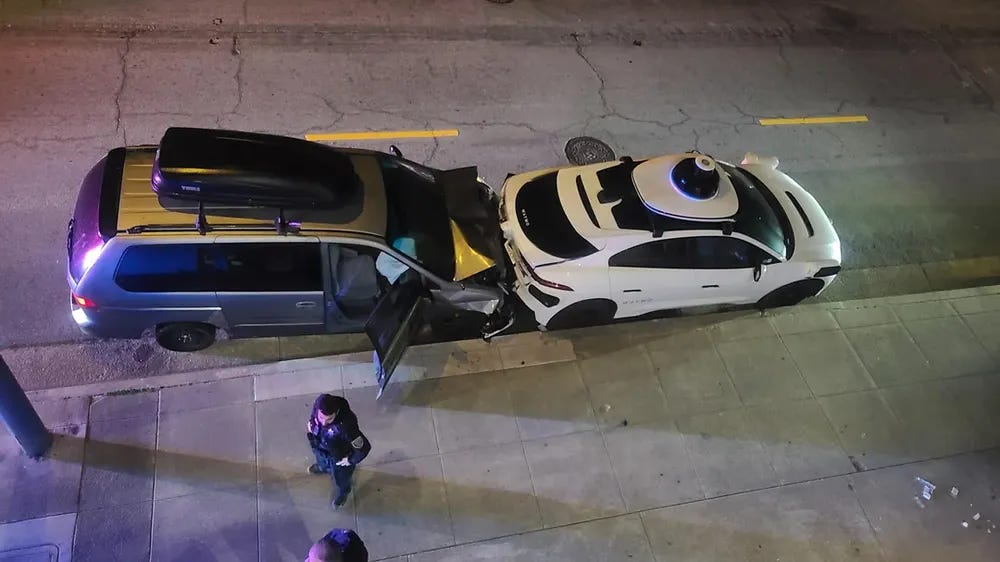
In at least one case, a Waymo got hit while stopped in a “no stopping” zone. Here’s a photo from one such crash in San Francisco:
We asked legal scholar Bryant Walker Smith how he thinks about Waymo’s responsibility in crashes like this.
He says it’s a complex question. “One way of looking at it is by saying, well, this was a lawful or unlawful place to stop or stand,” law professor Smith told us. “Another way of looking at it would be, well, would a taxi stop here?”
Finally, there were a couple of times when Waymo got rear-ended after what may have been phantom braking. In one crash, Waymo wrote that the Waymo stopped because of the “detection of a potential nearby emergency vehicle” — which may not have existed. In another crash, the Waymo started to move, then stopped and turned on its hazard lights. Waymo didn’t explain why its vehicle did this.
What about other robotaxi companies?
In this piece, we’ve focused on Waymo’s crashes. There are other companies in the US which have robotaxi deployments — notably, Zoox in Las Vegas, Tesla in Austin, and May Mobility in several small cities across the country. However, these deployments are much smaller and the companies are generally less transparent, so we have a lot less information about their services.3
Tesla reported two injury crashes in July 2025, but the company has reported zero crashes with injuries since August. It’s difficult to say anything more than this because Tesla redacts almost all of the important information from its crash reports to NHTSA — including the narrative of what happened.
May Mobility had two crashes over the period that resulted in an injury.
In an Atlanta crash in January, the safety driver “fell asleep while his right hand rested on the right side of the steering wheel.” This prevented the car from being able to steer, and the car hit a fire hydrant. The safety driver was sent to the hospital.
In Peachtree Corners, Georgia in August, a May Mobility autonomous shuttle was traveling in an AV-only lane on the right side of the road. A car in the next lane over turned right and was hit by the shuttle. According to May Mobility, the driver was “required to yield to through traffic in the AV lane.” At least one person was sent to the hospital, although it is not clear who.
Zoox had five crashes resulting in injuries:
In one case, a Zoox vehicle in a left-turn lane braked because a car in the oncoming left-turn lane “accelerated abruptly.” The Zoox was rear-ended, and the test driver reported an injury.
A Zoox ran into the door of a car while approaching an intersection. The driver claimed that the Zoox hit his hand; Zoox denies it: “Zoox vehicle camera footage shows clearly that no part of the robotaxi came into contact with the driver themselves.”
A Zoox stopped in a crosswalk to yield to an oncoming driver turning left. A scooterist entered the crosswalk “against the light,” swerved to avoid the Zoox, and hit the back-right corner of the car. The scooterist reported an injury.
A Zoox was changing lanes to the right in Santa Monica when it was hit by an SUV in that lane. It’s unclear from the report whether the Zoox cut off the other vehicle. The Zoox vehicle operator and two passengers reported “soreness and a headache.”
A Zoox collided with an SUV in San Francisco. The SUV had pulled into the parking lane but moved back into the road — “suddenly swerved” in Zoox’s words — and the two cars collided side by side. The right rear passenger of the Zoox reported “soreness.”
The Chinese robotaxi market is more opaque. While the most important Chinese companies have all logged significant mileage — Apollo Go announced in February that it had over 118 million miles of driverless operations — the Chinese government does not release public data about crashes. In fact, according to Steven Shladover, a UC Berkeley professor, “government censors take down any posting that the general public puts up” of AVs crashing or having problems in public.
So despite the scale of Chinese deployments, only a few robotaxi crashes have received significant outside coverage.
Perhaps the most important crash happened at the beginning of April in Wuhan. Apollo Go’s service appeared to suddenly shut down, with robotaxis shutting down and stopping across the city, including on freeways. Several crashes seemed to result from this incident.
Waymo hasn’t disclosed figures exactly corresponding to the time period we focused on in this article, but the company’s cumulative miles rose from 127 million in September 2025 to 170 million in December 2025. That’s almost 15 million miles per month. Waymo’s fleet and service territory have grown since December, so it seems very likely that over the seven months between mid-August and mid-March the company logged at least 100 million miles.
This category includes a September crash where a motorcyclist ran into the back of a Waymo that was turning into a parking lot. The collision threw the motorcyclist into the path of another car; the motorcyclist died at the hospital.
The crashes that follow are all the crashes that these companies reported to NHTSA from August through mid-March. Our Waymo analysis focuses only on crashes involving fully driverless vehicles with no safety driver. But because other companies have much smaller driverless operations, we’re including crashes with a safety driver in the car — as long as the car itself was in autonomous mode when the crash occurred.
I couldn’t be more averse to self driving cars in general. First of all, who asked the citizens if this is what we wanted in the first place? Secondly, why are we paying for these technologies, which are being controlled remotely and most-likely in another country entirely, with our tax dollars? I’m just not okay with it at all, and overly cautious drivers usually cause the most accidents anyway, just saying. Sudden braking is still a HUGE safety risk that should not be ignored.
First, thank you for this great article! Nice to have a full picture of the Waymo accidents and how humans actually play a bigger part in them. I think a lot of the anxiety and uncertainty people feel come from a fear of accepting new things which is very understandable.
About the Chinese government doesn't release public data about crashes, I think this is a misunderstanding. While China doesn't provide a centralized database like the DMV, the relevant data is not withheld from the public. The operation of autonomous vehicles in China is strictly regulated. For instance, companies like Apollo Go have explicitly stated that traffic accidents, such as being rear-ended, are reported to relevant regulatory authorities for the record immediately. Management committees or transportation authorities in certain operating regions, such as Wuhan and Beijing, periodically respond to incidents involving registered vehicles. Official data also indicates that the accident rate for driverless vehicles is approximately 1/14 that of human drivers.
As for "censorship", it's more of a broad censorship to tone down the public anxiety toward autonomous vehicles. Even then, on Chinese social media platforms like Douyin, Xiaohongshu, and Weibo, there is a vast amount of user-generated video and photographic content regarding Apollo Go vehicles getting stuck, involved in collisions, or causing traffic congestion, which frequently triggers large-scale public discussion. Mainstream Chinese media outlets, such as The Paper, Cailianshe, and Sina Finance, also track and report on autonomous driving accidents and obtain formal responses from either the government or the involved companies. There's a level of censorship, but it's no where close as "everything is taken down."