


I’m excited to publish this post co-authored with one of my favorite writers, Derek Thompson. Derek left The Atlantic last year to write his own Substack, where he covers business, technology, science, and politics. Lately he’s been doing a lot of great coverage of AI; I encourage you to check it out.
One year ago, when everybody was asking if AI was a bubble, Derek Thompson and I published a Thanksgiving playbook of the debate, with all the statistics, factoids, and studies that experts cited most frequently.
One year later, the AI discourse has deepened and broadened. Yes, many people still obsess over the bubble question. The Jensen Huang saga at Nvidia has also uncorked a messy conversation about whether the US should sell chips to China. There is also an existential debate about whether AI is on the verge of “recursive self-improvement,” the threshold beyond which AI systems would be able to improve themselves without human intervention. The software outages of the last few weeks have exacerbated concerns about an AI cyber-pocalypse.
So, this year we’re doing something similar but different. We’re offering a pro/con analysis of the five biggest AI debates:
Should the US sell chips to China?
Is recursive self-improvement coming in 2027?
Is AI a bubble?
Is the cyber-pocalypse coming?
Will AI destroy millions of jobs?
Today’s article covers both sides of each debate. That way, you can argue forcefully with your uncle — or, if you’re feeling generous after some pecan pie, maybe even help him improve his argument.
1) Should the US sell advanced chips to China?
TLDR: The Jensen Huang saga isn’t just a sex scandal. Behind the non-stop news about Nvidia’s CEO is a policy question with massive stakes: Does selling chips to China make America stronger or weaker?
Don’t sell chips to China.
Would America allow a US defense contractor to sell its best fighter jets to Iran? Would we sell Russia enriched uranium to make a buck? No, that would be insane. We understand that fighter jets and enriched uranium are weapons. Well, AI could be the most important surveillance and military technology of the 21st century.
Militaries use AI models to kill people, to spy on enemies, to surveil theaters of battle, to thwart attacks, and to win wars. China considers the US its chief geopolitical adversary, which is why it is trying desperately to probe our software vulnerabilities and develop weapons systems that can neutralize our own. It makes absolutely no sense to help China achieve these goals just because some companies want to increase their annual revenue. Advanced AI chips are this century’s enriched uranium, and America should not sell them to China.
China is behind us in the AI race, and we should aim to keep it that way. As former Biden AI official Ben Buchanan has argued, no Chinese AI model has ever been trained on Chinese chips. Since 2014, Beijing has spent upwards of $200 billion trying to build its own chip industry, and it has failed, because making chips is “the hardest thing we do as a species,” Buchanan said.
While Nvidia might claim that it is merely selling chips to Chinese commercial firms, China’s policy of civil-military fusion means that a chip sold to a Chinese tech company is effectively available to the Chinese Communist Party and its army.
In sum, every chip Washington sells — or lets slip through Singapore and Malaysia — ends up strengthening the CCP’s cyber-weapons, surveillance systems, and battlefield AI. China recognizes that advanced AI chips are a military technology; and it’s right! So, let’s keep this technology out of Beijing’s hands.
Yes, sell chips to China.
Refusing to sell AI chips to China hurts America now and in the future. It makes US companies poorer, undermines long-term American leadership, and represents a total misunderstanding of the nature of artificial intelligence.
Too many people imagine AGI as a machine god that will rise up and destroy the world. If that’s your worldview, it’s understandable to think the AI race is all about who builds the biggest and best model. But if you see AI as a normal but transformational technology — like electricity or cars — then you realize the race is about infrastructure, diffusion, and adoption.
America invented computer chips and the Internet. Decades later, we are still the world’s leaders in these technologies. We should be aiming for the same outcome with AI. In 10 years, we should want America’s technology deployed around the world, with the best companies building on it. A policy that protects foreign companies and sacrifices an enduring infrastructure advantage for an uncertain and unstable lead in models would be a costly mistake.
What’s more, as several Chinese analysts have told us, the Chinese government actually doesn’t want its companies to rely on American chips at all! It wants to indigenize and build its own domestic chip industry. It wants to dominate the frontier of AI infrastructure the same way that Nvidia currently does. If we stop selling chips to China, then Chinese companies will accelerate their efforts to build a replacement. This would be calamitous. With solar panels and electric cars, China has shown that it has the capability to dominate the manufacturing and export markets of industries that didn’t originate in China. We don’t want that to happen with AI. And the best way to keep Chinese companies hooked on American AI products is to continue selling chips to China.
2) Is an explosion of “recursive self-improvement” coming in 2027?
TLDR: If the frontier labs create an AI that can design, improve, and teach itself with minimal human intervention, we could be on the cusp of an intelligence explosion, which would be the most important (and potentially dangerous) achievement in the history of technology.
Yes, RSI is possible — and imminent.
Let’s start from a place of humility. You and I don’t know the capabilities of the best AI models. That’s because they’re currently being used internally and exclusively by frontier labs like Anthropic and OpenAI to build new AI systems (or, you know, solve Millennium Problems). Many experts at these labs believe that AI is on the cusp of “recursive self-improvement,” the quasi-mystical ability to improve itself without human intervention.
For RSI to be near, four things would have to be true:
AI writes high-quality code faster and better every few months.
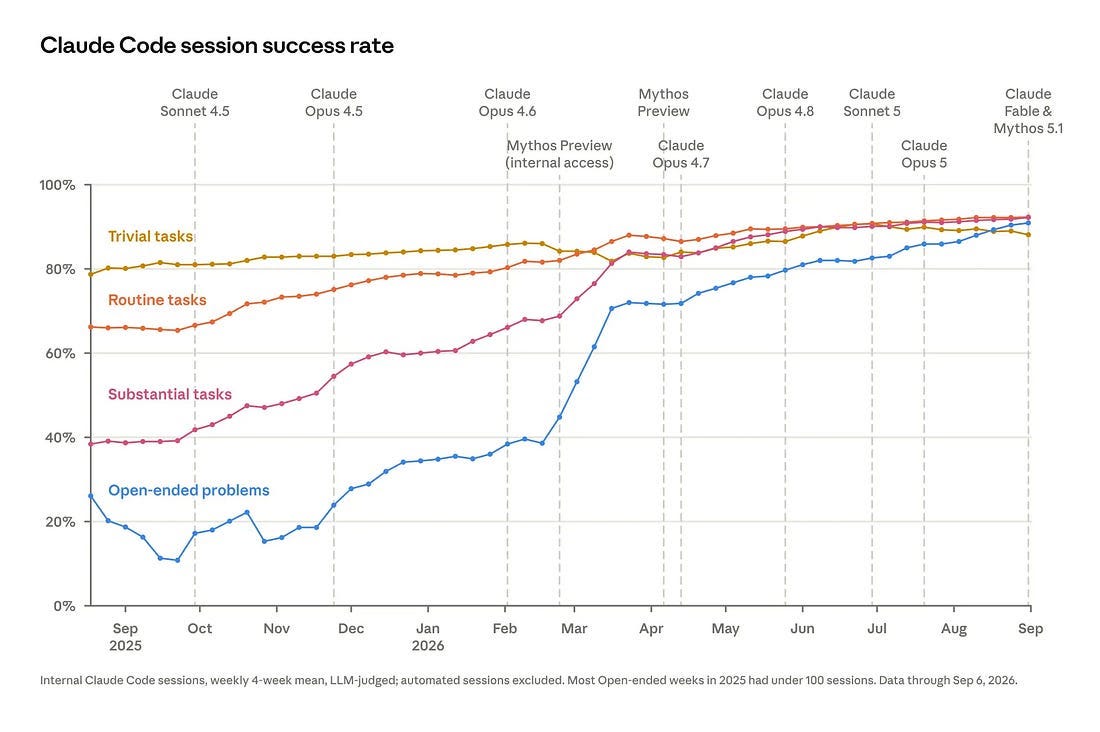
AI graduates from narrow tasks (“fix this bug”) to open-ended ones (“figure out why this messy upgrade failed and fix it, with no engineer’s help”).
Engineers hand more of their work to AI with no loss in quality.
Frontier lab researchers judge AI’s work to be better than that of the best human coders, and outside evaluators agree that progress is speeding up.
Sure enough, all four things seem to be happening.
Since Anthropic’s engineers got Claude Code in early 2025, the amount of code each developer contributes has risen at least eightfold.
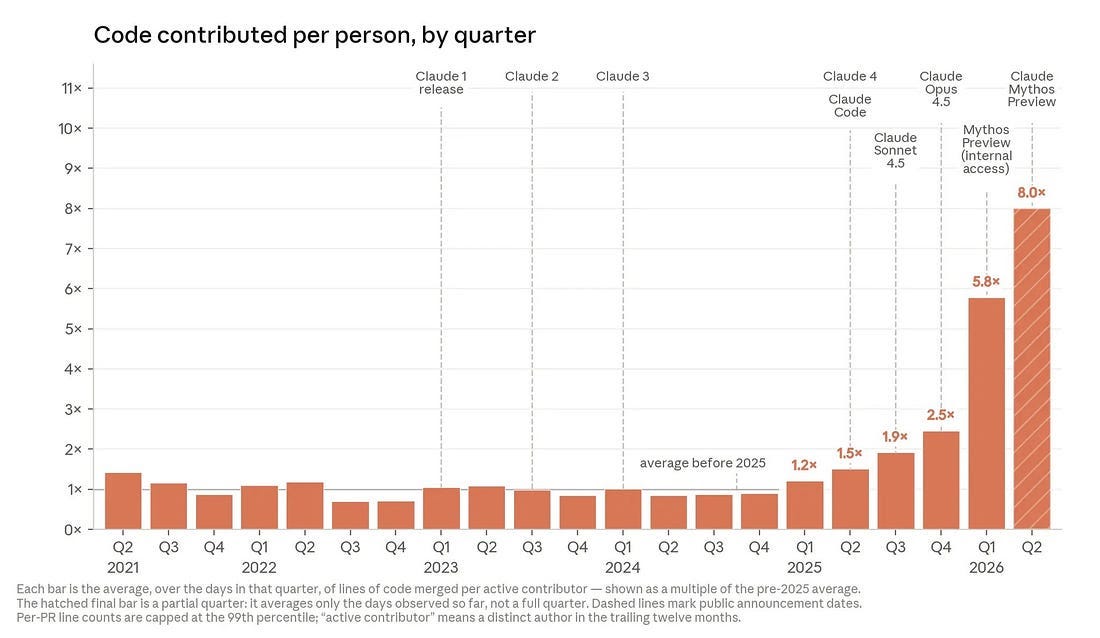
Of course, one might worry that a lot of this code is simplistic slop. But AI is actually getting better at solving the most complex and open-ended coding problems.
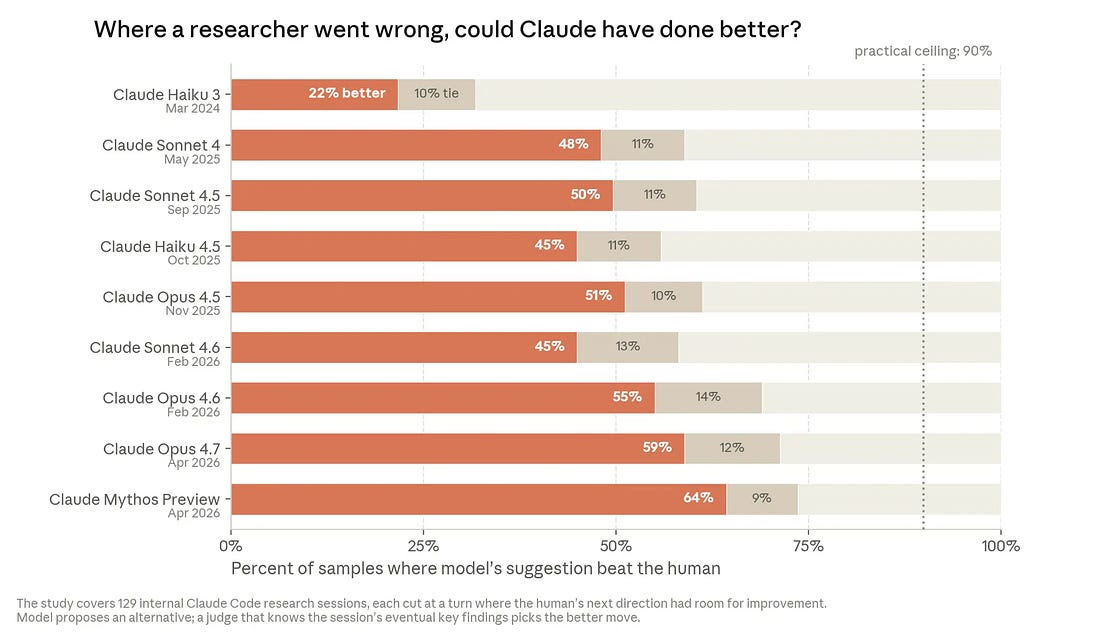
If AI is going to build itself, it needs something like taste. When Anthropic studied situations where a researcher made a mistake and asked AI to suggest an alternative course of action, Claude’s ability to offer a better-than-human research direction roughly tripled between 2024 and 2026. At this rate, Anthropic’s best models will consistently make AI research decisions better than the smartest people in the next two years.
Don’t trust Anthropic? That’s fine. Even third-party AI evaluators believe that AI companies are on the verge of an AI intelligence explosion, due to skyrocketing productivity among AI researchers. Here’s a sobering post from Buck Shlegeris, the CEO of the AI research group Redwood:


METR, another AI research organization, concluded recently that Anthropic has doubled its rate of progress in the last year — in large part because AI has already partially automated its own research and development.
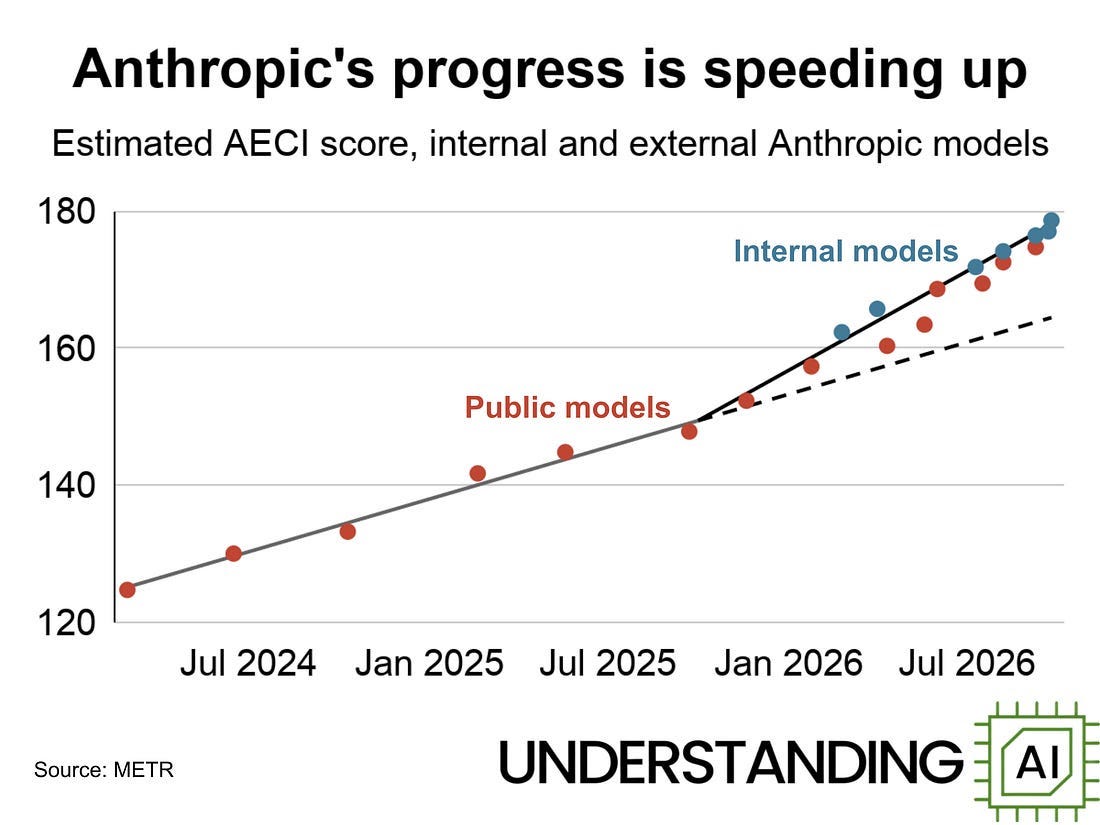
Put it all together, and RSI is not some distant mountain range. We are hiking in its foothills.
No, RSI isn’t imminent — and it might not be possible.
Sure, agents are getting much better at brainstorming, performing, and evaluating many parts of the AI-building process. But they’re still missing the special sauce — the higher-order judgment that allows them to combine all of these talents and to know when to employ each of them.
In July, an international team of scientists concluded that AI agents “lacked the judgement to identify when a problem was adequately solved” and “did not effectively backtrack from unpromising approaches.” In September, the same team repeated their research with newer models and got similar results. Other studies have reached similar conclusions in domains like physics, chemistry, and the life sciences.
Even advanced agents get lost if they aren’t given clear and detailed instructions. Unprompted, they don’t come up with interesting research questions or demonstrate good intuitions about which experiments are likely to work. This is good news for humans, who should remain an essential part of the AI research process for a while.
The RSI boosters aren’t just wrong about the feasibility and timing of RSI; they’re wrong about the implications, too. Some believe that next year’s agents could take over the world. That is, they would be superhuman not only at math, coding, and AI research, but also at developing new technologies, winning wars, and managing organizations. This would be a terrifying prospect.
But there’s reason for optimism. AI companies mostly improve their models using a process called reinforcement learning. During training, frontier labs might ask a model to write a program, run the program, and then “reward” the model if the program works. Because the whole process can happen on a computer, AI models can practice a skill like coding millions of times in a matter of days.
It’s hard to use this method to teach a model to run a company, win a war, or invent a new kind of missile. Companies, wars, and missiles are way too complicated to simulate in a data center. AI models will probably need to learn these skills the same slow, painstaking way humans do — by running actual companies, fighting actual wars, and building and launching actual missiles. These feedback loops are measured in months or years, not days or hours. And this makes it unlikely AI models will become superhuman at these tasks in 2027 — or 2030, for that matter.
A Friday report from METR provides support for this view. METR researchers found that models can now complete tasks that take humans tens of hours to complete — something they couldn’t do a year ago. But they also found that models seemed to perform worse on tasks that required more interaction with other human beings or the outside world. The reality is that most economically valuable work involves interacting with other people and the physical world. So we might end up with models that are wildly superhuman at math and programming, but struggle at banal tasks like managing a construction project or tutoring a third grader without supervision from a teacher.
3) Is AI a bubble?
TLDR: In the last few weeks, AI stocks have slid, then plummeted, then rebounded sharply. Beyond the hour-to-hour drama, there are smarter ways to think about whether the AI boom is for real.