

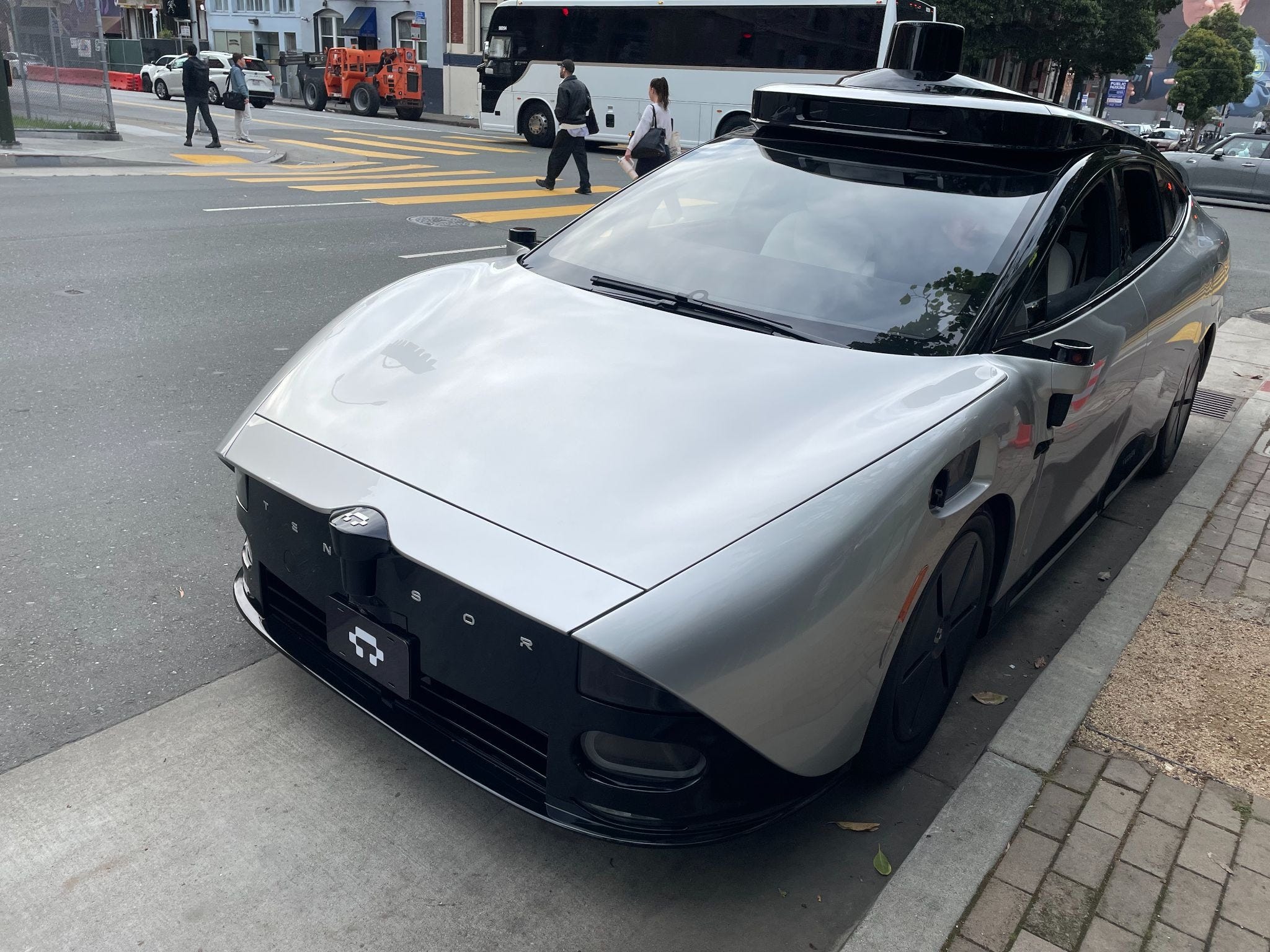
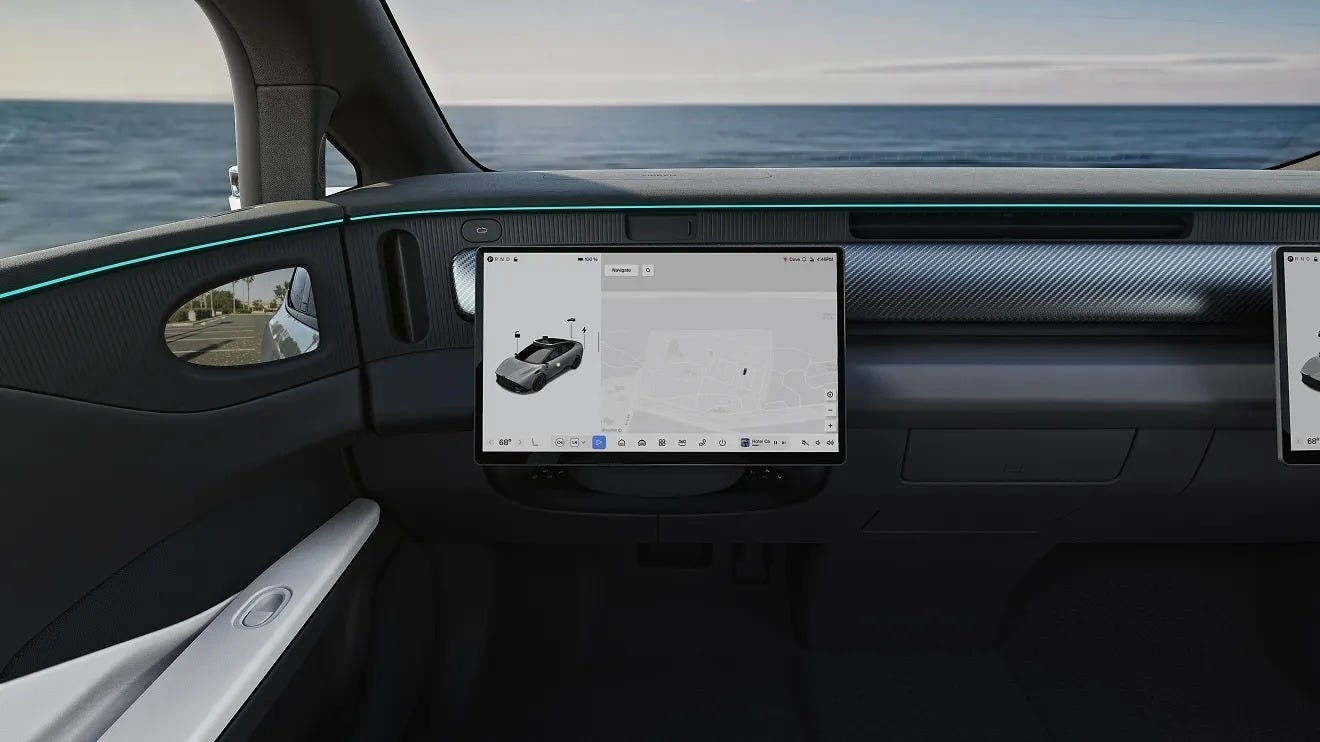
Last month I got to check out a self-driving car unlike any I’d seen before. The roof had a Waymo-like rack of sensors. Inside, the doors had small video screens instead of side mirrors. At the touch of a button, the rectangular steering wheel folded into the dashboard and a video screen slid in front of it, putting the car into self-driving mode.
The prototype vehicle, made by a startup called Tensor, was parked on a San Francisco street outside the Ride AI conference. I didn’t get a demo ride because the vehicle isn’t yet street-legal. But I sat in the passenger seat next to Tensor chief marketing officer Amy Luca, who explained the company’s history and launch plans.
Tensor was previously known as AutoX. Founded in 2016, the company once tested a grocery delivery service in California and developed a robotaxi service in China. But it ended those experiments a few years ago. Last year the company rebranded as Tensor and announced a new business model: building fully self-driving cars for customers to buy.
Tensor is aiming to become the first company in the world to do this. It plans to launch in the tech-friendly United Arab Emirates later this year. If all goes well, customers in the United States will be able to purchase a Tensor vehicle next year.
Tesla also wants to sell the first fully driverless vehicles — indeed, it has been claiming for almost a decade that its cars have the necessary hardware. But that has proven overly optimistic, and Tesla has not yet enabled unsupervised self-driving on customer-owned vehicles.
One challenge has been computing power. From 2019 to 2023, for example, Tesla sold cars with custom-designed “Hardware 3” chips capable of 144 trillion operations per second (TOPS). Elon Musk now admits that these vehicles are unlikely to have enough computing power for unsupervised self-driving. The next iteration of Tesla’s chip, called AI 5, will reportedly be capable of 2,500 TOPS.
Tensor is aiming even higher: each vehicle will have eight Nvidia Thor GPUs, for a combined computing power of 8,000 TOPS.1 One version of this chip retails for $3,499, so Tensor’s onboard computing power alone may cost tens of thousands of dollars.
When I asked Luca how much a Tensor car would cost, she smiled and replied with one word: “luxury.” Waymo vehicles are rumored to cost around $150,000 each. I would not be surprised if Tensor prices its first vehicle even higher.
Most cars have an engine in the front. Electric cars don’t have an internal combustion engine, so some — like Tesla’s — have extra storage space there instead. Tensor’s car is also electric, but rather than a Tesla-style “frunk,” it has a massive water tank to clean the vehicle’s cameras and sensors.
“Owners are not going to want to have to go out and clean and recalibrate their sensors every day,” Luca told me. So the tank is designed to last for months between refills.
Every few months, a Tensor vehicle might drive itself to the nearest dealership for routine maintenance and sensor calibration.2 Indeed, Tensor will likely insist on this for liability reasons: a defective or misaligned sensor could lead to a crash and then a lawsuit against Tensor.
Will customers have to pay a monthly fee for service and support? Luca said yes. If a sensor breaks, will the customer have to pay for it? “It depends on how it broke,” Luca told me.
I wish Tensor the best, but I think this is going to be a hard sell.