

I have a reputation as a Tesla skeptic, and something I regularly hear from Tesla owners is “you need to try the latest version of Tesla’s FSD technology — it wasn’t that good a year ago but it’s really impressive now.” I take comments like this seriously, and I try to drive (or ride) in Teslas as often as I can. But I also think people who say this tend to underestimate how difficult it is to judge autonomous systems based on casual observation.
I’m in San Francisco this week, and one of my goals has been to ride in as many autonomous vehicles as possible. So far I’ve taken three Waymo rides and one ride each from Zoox and Tesla. I plan to do a few more Tesla rides this weekend.
The rides so far have all been basically flawless. None of the vehicles made any major mistakes. In only one case — the Zoox ride — did a vehicle seem to make a minor mistake.1
But here’s the thing: the industry has reached a point where we shouldn’t expect any mistakes to occur in a typical ride — or, for that matter, in 10 or 100 typical rides. AV companies are aiming to exceed human performance, and human drivers go tens of thousands of miles between serious crashes. So even if you observe a self-driving system driving flawlessly for many hours, this doesn’t tell you very much about whether its performance is at the cutting edge.
For that you need data from large-scale deployments. Waymo, for example, says its vehicles have driven more than 270 million driverless miles through July 2026. That should be enough data to make statistically rigorous comparisons between human drivers and Waymo’s vehicles.
But there’s a bit of a chicken-and-egg problem when a new company wants to launch a commercial service. We’d like to know whether an AV system is safe before we allow large-scale deployment on public streets. But there’s no other way to get the necessary data. Even if a company drove tens of millions of miles on a private test track, the resulting data wouldn’t tell us very much; public roads are far more chaotic and unpredictable than any private facility.
And crash data is most informative when it comes from a full-scale commercial deployment. If a company only operates in a few designated routes, we can’t be sure its performance will generalize to other parts of a city. Similarly, a vehicle’s performance with safety drivers won’t necessarily predict its performance without them.
That’s not to say that testing on limited routes and with safety drivers is a bad idea — it just needs to be viewed as a stepping stone toward full-scale commercial deployment.
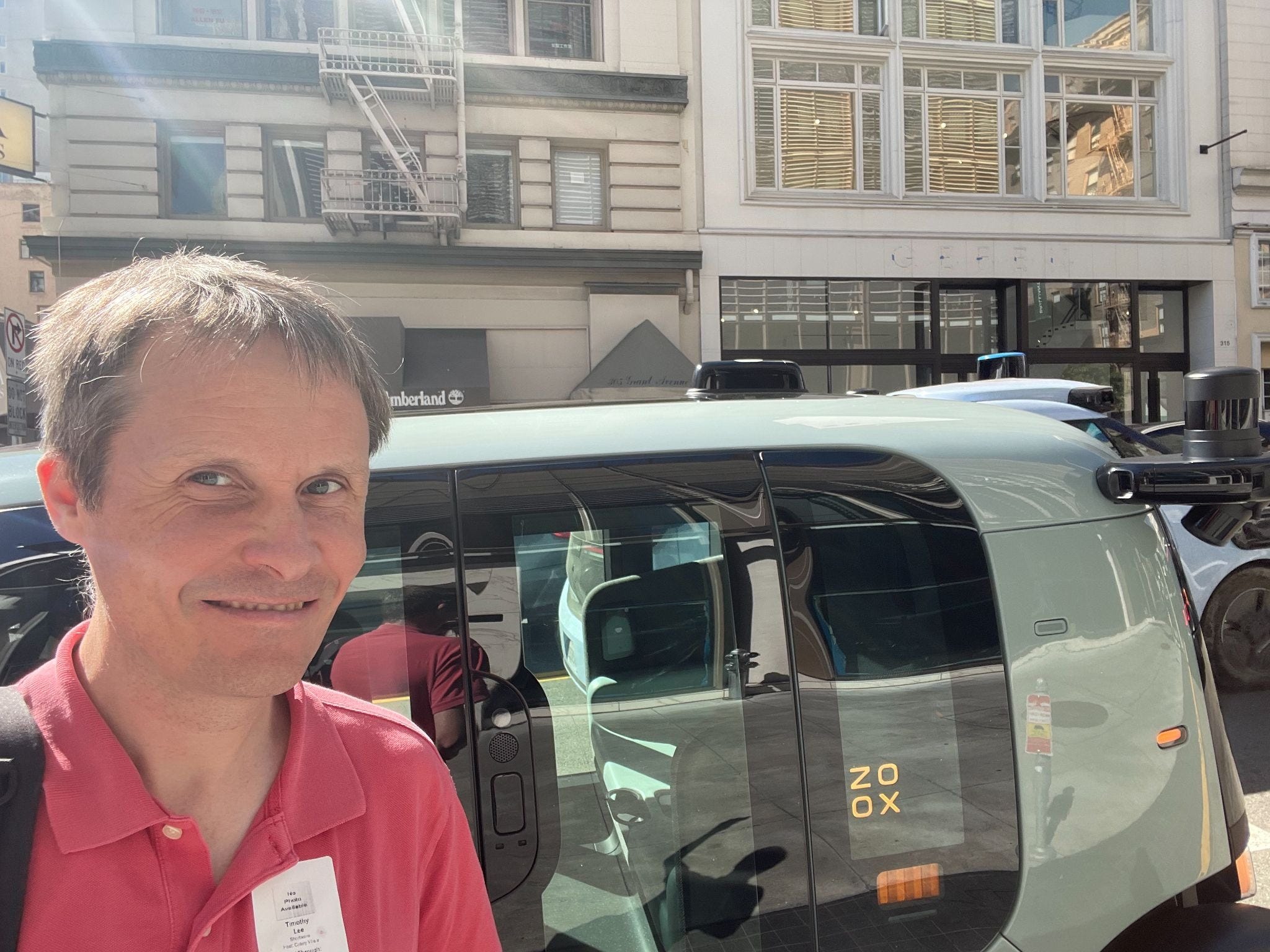
And that brings me to my robotaxi experiences this week. Zoox has yet to launch a full-scale commercial service in San Francisco — Zoox has an invite-only list of “Zoox Explorers” who are eligible to use its service for free in San Francisco. But those of us not in the Explorers program have to travel to the Zoox Rider Lounge, a storefront that lets customers sign up for free Zoox rides. Rides must start in front of the store and end at one of a dozen or so hand-picked destinations.
So not only is Zoox’s operation far smaller than Waymo’s city-wide commercial service, Zoox may have chosen routes that would be relatively easy for its vehicles to complete.
In contrast Tesla serves a huge territory in the San Francisco Bay Area, ranging from San Jose in the South to Berkeley in the Northeast. There are no cherry-picked routes here. However, all of Tesla’s California Robotaxis have safety drivers behind the wheel.
These factors cause me to discount the generally excellent driving experience I had with both Zoox and Tesla in California. It’s easier to deliver a safe, pleasant drive on a few handpicked routes than citywide. And it’s easier to have a vehicle driver smoothly and confidently when a human driver is ready to intervene if the vehicle makes a mistake.
At this point, the only way to judge robotaxi performance is by large-scale, driverless commercial deployments. Waymo has done that in California. Tesla and Zoox have not.
The picture is different in Texas
So far, California regulators have required all Tesla vehicles in California to have a safety driver behind the wheel. That’s not true in Texas, and Tesla began operating fully driverless vehicles in Austin in January. At the time there were only a handful of driverless vehicles in Tesla’s Texas fleet — the rest still had human monitors in the passenger seat. By April, Tesla’s driverless fleet in Texas had grown to around 25 vehicles. Then over the summer, Tesla’s overall fleet ramped up dramatically. At the end of July, Tesla had 181 Model Y vehicles registered for Robotaxi operations in Texas. Today the number is 578.
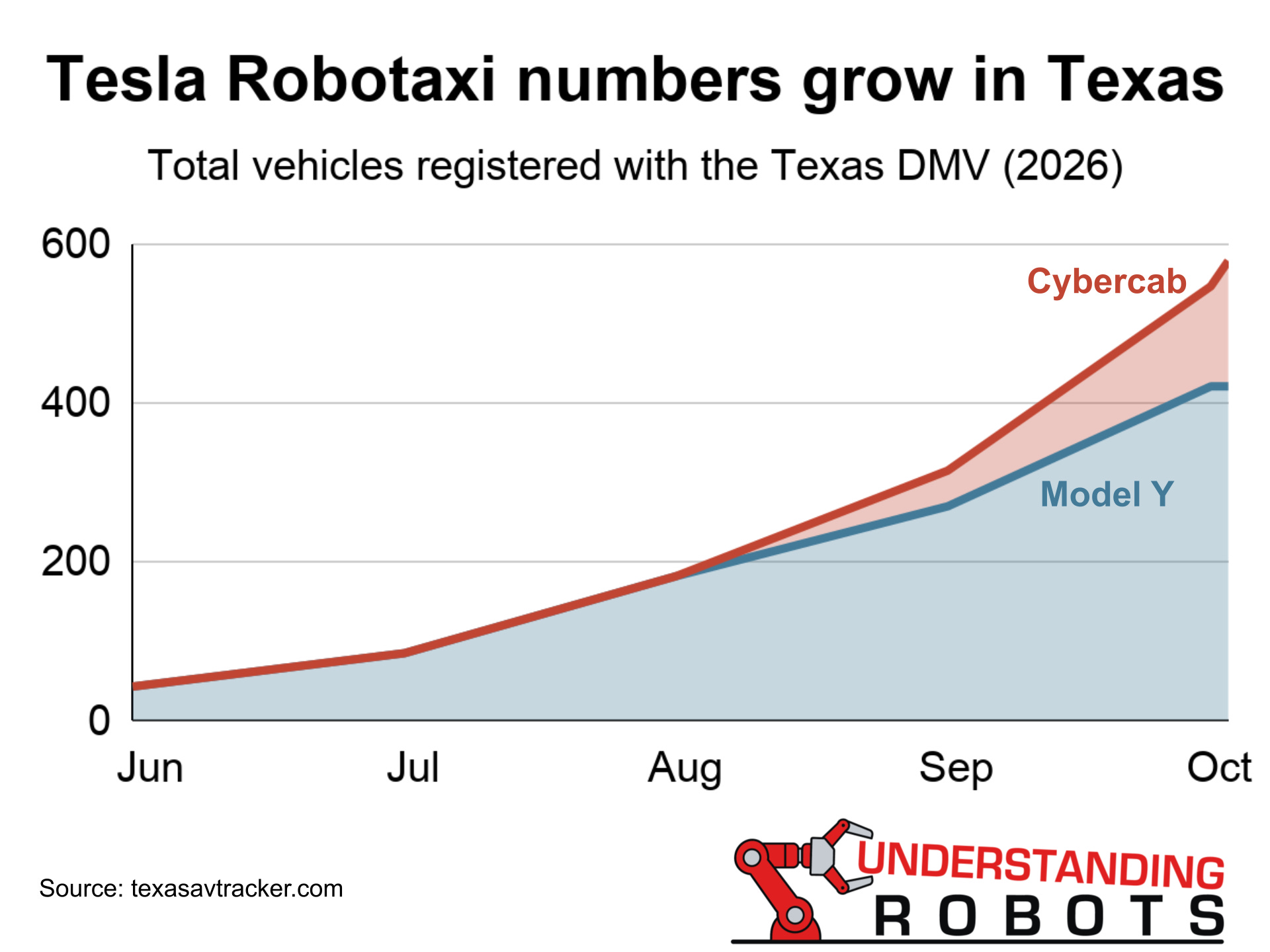
We don’t know how many of these vehicles were operating without in-car human supervision. But it’s notable that Tesla now has 158 Cybercabs registered in the state, including 32 that were added in the last week. These vehicles have no pedal or steering wheel and are designed exclusively for driverless operation. So Tesla’s driverless fleet in Texas is at least 158 vehicles, and possibly significantly more than that. Tesla also has a growing number of driverless vehicles in Florida.
We don’t yet have good data on the safety record of these vehicles, and we shouldn’t draw any firm conclusions about Tesla’s safety record until we do. It’s certainly possible that Tesla Robotaxis will be involved in serious crashes in the coming months and Tesla will be forced to slow its expansion. But at a minimum, the decision to scale up driverless service seems like a credible signal that Tesla believes its technology is safe enough for large-scale deployment.
For its part, Zoox has a commercial robotaxi service in Las Vegas using its purpose-built vehicles with no steering wheels or pedals. However, it’s a point-to-point service that travels to a fixed list of destinations such as hotels and the airport. This is more limited than the general taxi services offered by Waymo and Tesla.
A couple of weeks ago, Techcrunch reported that Zoox had about 100 of its custom-designed vehicles nationwide. That’s fewer driverless vehicles than Tesla and a lot fewer than Waymo, which has around 4,000 vehicles. And we don’t know how many of them are being actively used to provide rides to the public.
My Zoox vehicle approached a portable road sign that was blocking the right lane. There were no cars nearby, so the vehicle (which is symmetrical from front to rear) went into reverse for about 100 feet to give itself room to change lanes and then continue forward in the next lane over. But an experienced human driver would have presumably seen the obstacle ahead and changed lanes before reaching it.