

Sen. Bernie Sanders (I-VT) is getting serious about AI.
“In my view, and in the view of people who know a lot more about this issue than I do, we are in the beginning of the most profound technological revolution in world history,” Sanders said at a March 25 press conference. “Artificial intelligence and robotics will impact our economy, our democracy, our privacy rights, our emotional well-being, and even our very survival as human beings on this planet.”
In response, Sanders and Rep. Alexandria Ocasio-Cortez (D-NY) introduced a bill to ban data center construction “until Congress passes comprehensive AI legislation.”
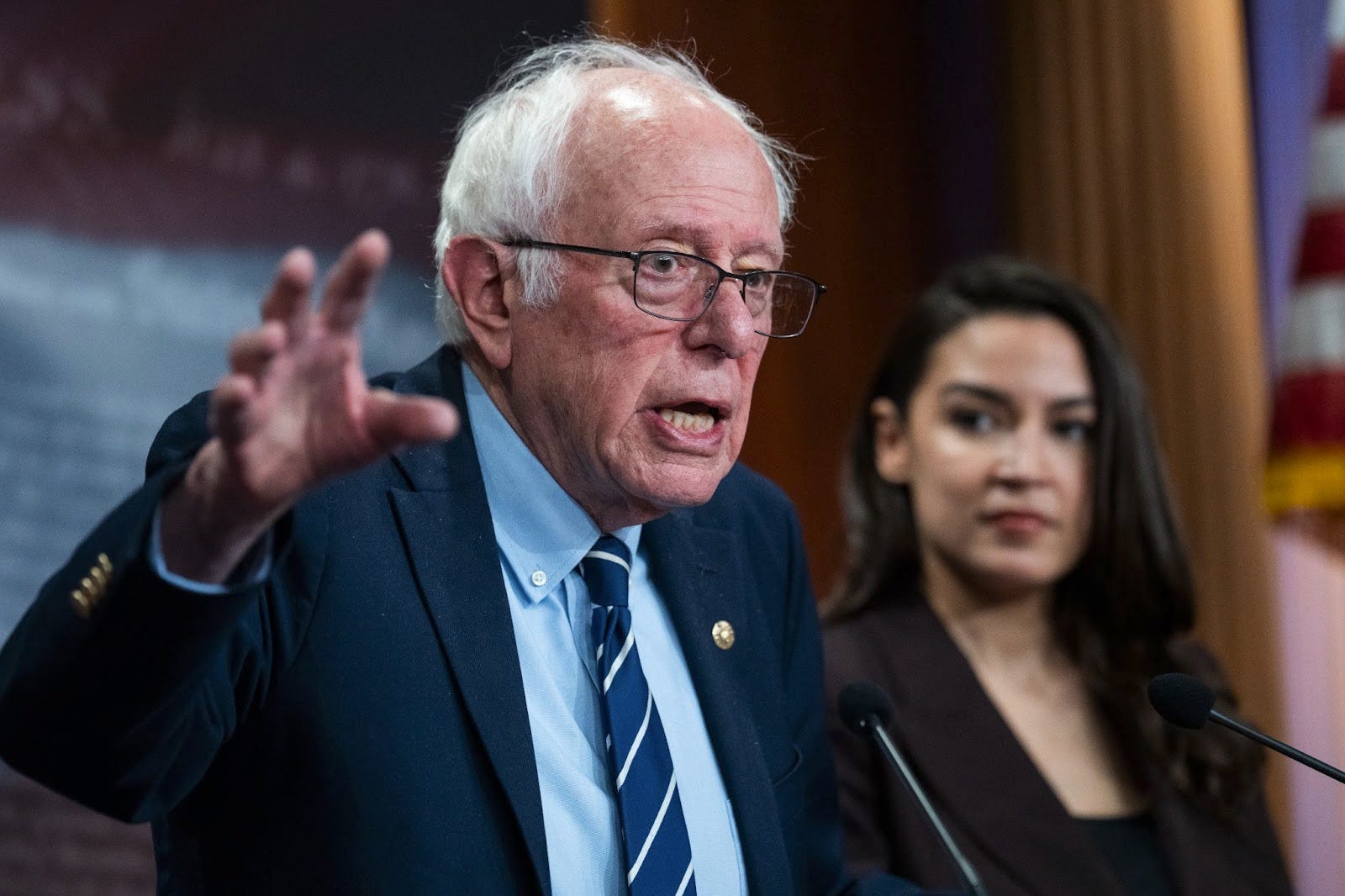
Many Americans share their AI skepticism. One recent NBC survey found that only 26% of Americans had a positive impression of AI, while 46% were negative.
There’s a potential here to build an anti-AI movement that could be a political juggernaut.
There are potential allies across the political spectrum, from Sanders to Ron DeSantis, the Republican governor of Florida. When asked in February about the risks of AI, Missouri Sen. Josh Hawley said that Americans losing access to paying jobs was “at the top of the list.” The conservative Republican teamed up with moderate Sen. Mark Warner (D-VA) on legislation to track job losses from AI.
Prominent AI experts are warning that the technology poses existential risks to humanity. Child safety advocates worry that chatbots will expose teens to inappropriate content and worsen their mental health. Labor groups — from taxi drivers to Hollywood actors — are trying to stop AI from taking their jobs. And activists nationwide want to stop construction of data centers in their own backyards.
However, it’s unclear whether these groups will be able to unite into an effective coalition. While many people are hostile toward the AI industry, they don’t always agree about the nature of the threat or what to do about it.
While some opponents see AI as an existential risk to humanity, others dismiss those warnings as part of an AI industry hype campaign. Grassroots campaigns against data centers tend to focus on their excessive water use, but some AI safety advocates believe (correctly) that the water issue is greatly exaggerated. After local activists stop a data center in their own neighborhood, they may not stay engaged with larger questions about the overall impact of AI.
So while there is the potential for these groups to work together — Sanders is clearly trying to make that happen — there’s no guarantee that it will work. It seems more likely that the AI industry will continue its relentless growth even though almost half of Americans wish it would slow down.
The pause people
On Saturday, March 21, I attended “Stop the AI Race,” the largest AI safety protest in US history. Activists at the San Francisco event worry that superintelligent AI could seize control of the world and kill all human beings.
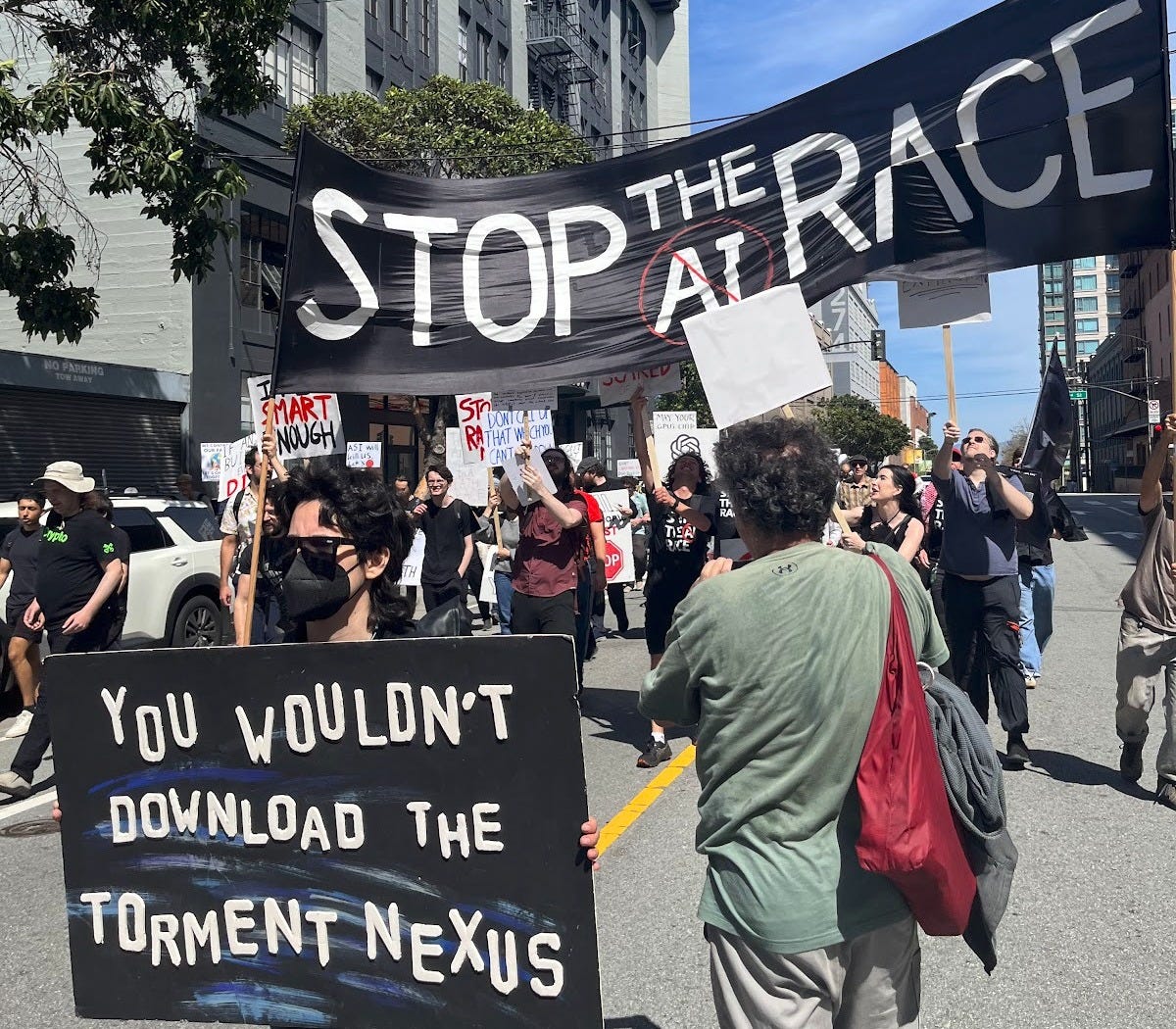
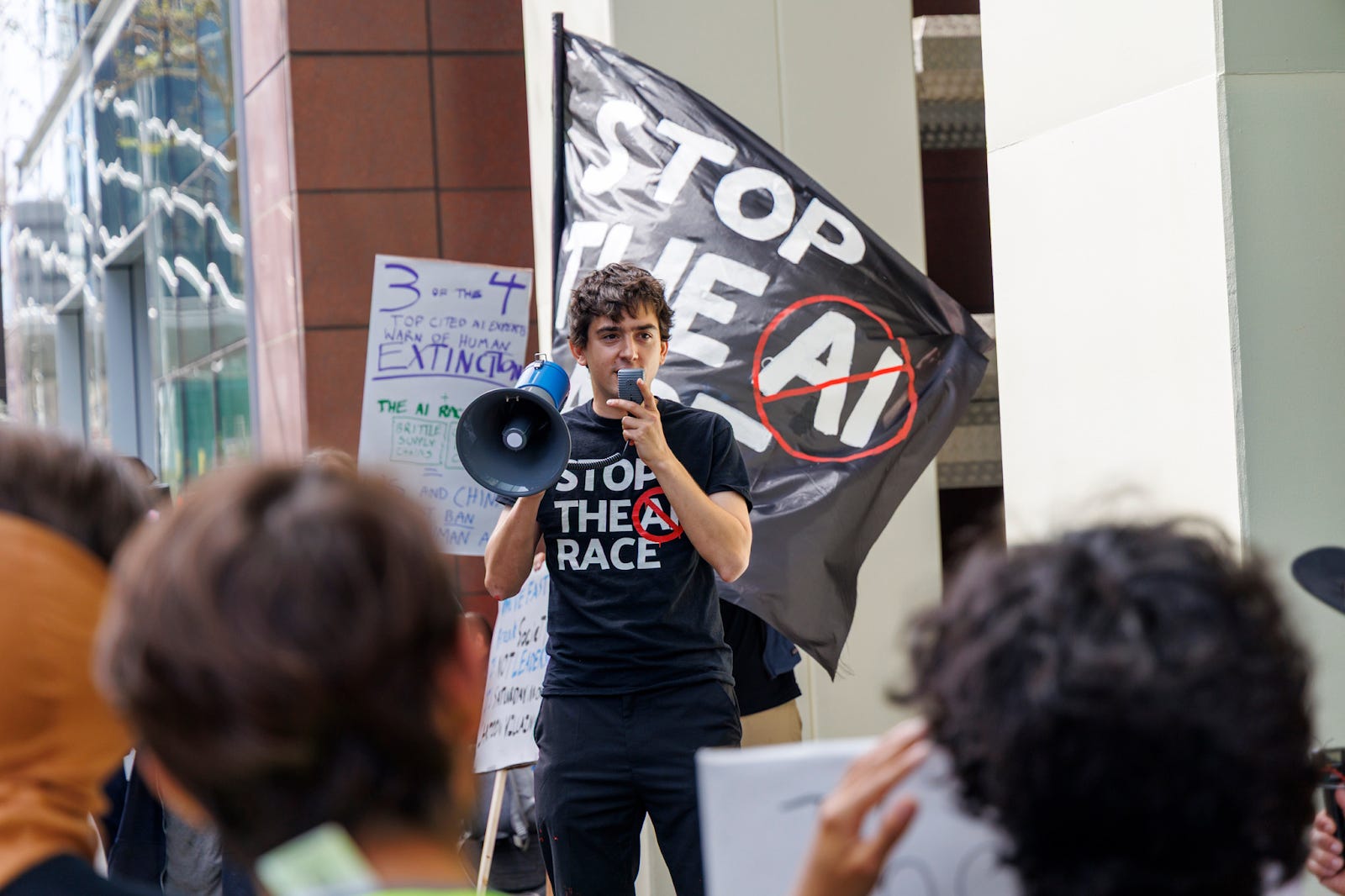
“For the past fifteen years, I’ve watched in slow motion as humanity has sleepwalked closer and closer to suicide,” said David Krueger, a University of Montreal professor involved in organizing the event, in a speech in front of Anthropic’s headquarters.
“This technology threatens everybody’s life, and it’s not okay to pretend like this is normal,” said another speaker, Nate Soares, co-author of If Anyone Builds It, Everyone Dies.
Not everyone attending was mainly concerned about existential risk — a couple of the speakers focused on AI chatbots encouraging teens to commit suicide, for instance. But most people I talked with seemed primarily worried about AI taking over the world and killing people.
It’s not a new concern. In the early 2000s, Soares’s co-author Eliezer Yudkowsky started writing about the catastrophic risks that advanced AI might pose. Nor is it uncommon in AI circles. Legendary AI researchers like Geoffrey Hinton and Yoshua Bengio have similar concerns. Industry leaders like Elon Musk and Sam Altman have also warned about existential dangers from AI.
People concerned with AI safety have tended to play “an inside game,” as Alys Key put it in Transformer.1 They’ve often eschewed public activism in favor of technical research and elite persuasion.
The “Stop the AI Race” protest represents a step toward more public activism, but the protest was still largely focused on persuading specific elite actors.
“We didn’t try to have the largest anti-AI protest possible,” the protest’s head organizer, Michaël Trazzi, wrote to me. “Instead [we] tried to focus on some specific pause AI ask that we thought [AI company] leadership / employees could get behind.”
This strategy was informed by Trazzi’s experience conducting a hunger strike. In September, Trazzi and another protester, Denys Sheremet, spent two and a half weeks sitting in front of the Google DeepMind office, demanding that Google commit to stop releasing models if everyone else agreed to stop.
Trazzi and Sheremet stopped for health reasons before Google agreed to the request, but Trazzi still views it as a success. The protest attracted significant media attention, and four months later, Google DeepMind CEO Demis Hassabis replied “I think so” when a journalist asked him at Davos if he’d advocate for a pause that all the other companies were participating in.
Trazzi told me support from Google employees was crucial to the hunger strike; he looked to replicate this dynamic with Anthropic. “Our main goal with this protest was to address the employees of Anthropic who, when they joined, thought the company would scale responsibly,” he wrote to me.
The concrete details of what an AI pause might look like are complicated, technical, and liable to generate disagreement. Trazzi’s campaign for a conditional pause has elided these details, helping to bring a larger coalition together. Previous US AI safety protests had been closer to 25 people. Stop the AI Race got 200 people to show up.
Leftists and AI safety advocates haven’t always gotten along
Several times throughout the San Francisco protest, Trazzi and others expressed excitement that “we have Bernie on our side.” But when leftists and AI safety advocates have tried to work together, it hasn’t always gone well.
Phil Hazelden is a programmer who believes AI poses an existential risk to humanity. He attended a February 28 UK protest co-organized by the AI safety group Pause AI and a left-leaning group called Pull the Plug. Hazelden concluded that “unfortunately, most of the speeches were frankly dumb.”
“Mostly I felt like the vibe was a sort of generic lefty anti-big-tech thing, which is not something I want to lend weight to,” he wrote. “I think it’s important for different groups to be able to ally on points of common interest, even if they have deep enduring disagreements. But this didn’t particularly feel like the other group was cooperating with me on that.”
As Politico reported, AI risk groups and the Sanders camp sometimes back dueling candidates in Democratic primaries. In North Carolina’s fourth district, for example, Rep. Valerie Foushee faced a primary challenge from Sanders-endorsed Nida Allam. Foushee narrowly defeated Allam in a March vote. Among Foushee’s backers was a super PAC led by prominent AI safety advocate Brad Carson.
Few politicians in America are more closely identified with AI risk concerns than Scott Wiener, the California state senator who proposed SB 1047, an AI safety bill that Gavin Newsom vetoed in 2024. Wiener is currently running to replace Rep. Nancy Pelosi (D-CA) in Congress. He is facing Saikat Chakrabarti, the former chief of staff to Rep. Alexandria Ocasio-Cortez (D-NY).
The hard reality for AI safety advocates is that — at least for now — their numbers are small. They need allies if they want to build a mass movement.
Data center opponents have had some victories
It has proven much easier to organize grassroots opposition to local data centers; voters across the political spectrum pay attention when major construction projects are proposed in their own backyards.
For example, on September 23, 2025, hundreds of people showed up to a planning commission meeting in Howell Township, a municipality of around 8,000 in southern Michigan. The planning commission had to move the meeting to a larger space in order to accommodate everyone.
“Normally we have like three people at our meetings,” vice chair Robert Spaulding told the crowd. “Have some grace with us.”
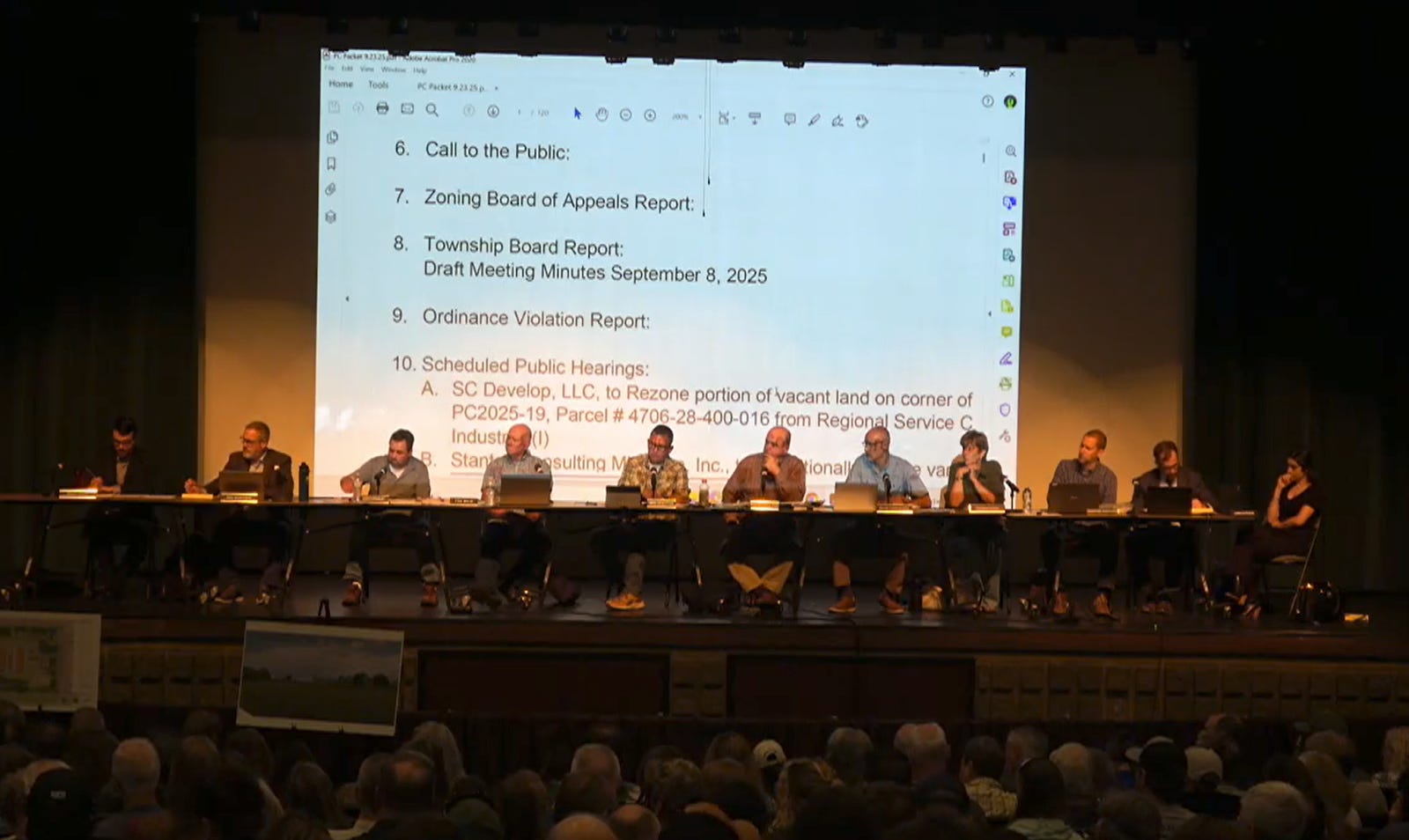
People were protesting a proposed zoning exemption for a billion-dollar data center project reportedly built for Meta. Over a hundred people spoke against the plan at a meeting that went past 2 AM.
Across the US, local groups have fought against data center development through protests, testimony at public hearings, and lawsuits.
Often these groups are quite diverse: “We got the goth people that came with black, baggy pants and rings in their noses and grandmas with walkers. It goes from one extreme to the other. It’s not political,” Dan Bonello, an organizer against the Howell data center, told the Livingston Daily.
The concerns vary by community, of course, but several show up over and over.
Perhaps the most common concern is that data centers will use too much water. Almost two-thirds of the Howell speakers mentioned water usage. Nationally it is the “No. 1 reason cited in press accounts for local opposition” to data center projects, according to an analysis by Heatmap.
In reality, data centers don’t use much water compared to other uses, such as factories, agriculture, or leisure.
Electricity rates are another flashpoint. Data centers really do use a lot of electricity, and the costs of infrastructure upgrades are sometimes passed on to all ratepayers.
“When I go home, people are very, very concerned about their electricity bills going up,” Sen. Josh Hawley (R-MO) said at the Axios AI+ Summit in DC. Hyperscalers like Microsoft have pledged not to pass on rate increases, but many voters remain unconvinced. A promise to lower electricity rates vaulted Democrats to Georgia’s Public Service Commission for the first time in over 20 years.
There are also classic NIMBY concerns: “The data center complex doesn’t belong here. It will destroy our rural nature that we all love so much,” one speaker told the planning commission in Howell Township.
Grassroots activism like this is often successful. In Howell, the town issued a six-month moratorium on data center development in November 2025; the proposed project was later withdrawn. Nationally, Heatmap found that “over 25 data center projects were canceled last year following local opposition.” That corresponds to more than $50 billion in spending by AI companies. 40% of the time there was local opposition, the project ended up canceled.
Still, many opposed to data centers have narrow enough goals that it may be difficult to harness them into a broader coalition. As Paresh Dave points out in Wired, “many of the factories getting built to supply servers, electrical gear, and other parts to data centers are facing virtually no opposition.”
Local pushback may just push data centers elsewhere. For instance, after a developer withdrew a data center project in Matthews, North Carolina, it pivoted to proposing a similar project a hundred miles north in Stokes County, North Carolina. Data centers may also end up being built abroad; last July, for example, OpenAI announced it was building a gigawatt data center in the UAE.
There are some signs that data center activists are becoming more ambitious. Legislation has been proposed in 12 states to temporarily ban new data center development. But for now, much of the activity — and the success — has come from decentralized local efforts.
Labor is focused on contract fights
A third major concern is that AI will take human jobs.
While this garners concern across the political spectrum, job loss has been a particular focus on the left, especially among unions.
Brian Merchant writes the newsletter Blood in the Machine, which has a recurring segment called AI Killed My Job.
“A lot of people in the labor movement understand AI less as a novel technology and more of the latest iteration in automation or surveillance technology,” Merchant told me. “It’s already being used to replace jobs or tasks when it can, erode working conditions, increase surveillance, and give the management class a powerful tool to do all of the above.”
But there isn’t one clear policy aim like pausing AI development or shutting down the construction of data centers.
“If you were to ask the head of the AFL-CIO [the largest union in the US] ‘What do you want to happen with AI policy?’ I don’t think there would be a clear answer,” Merchant told me.
Unions have tried to limit the use of AI during contract negotiations, as in the Hollywood strikes of 2023.
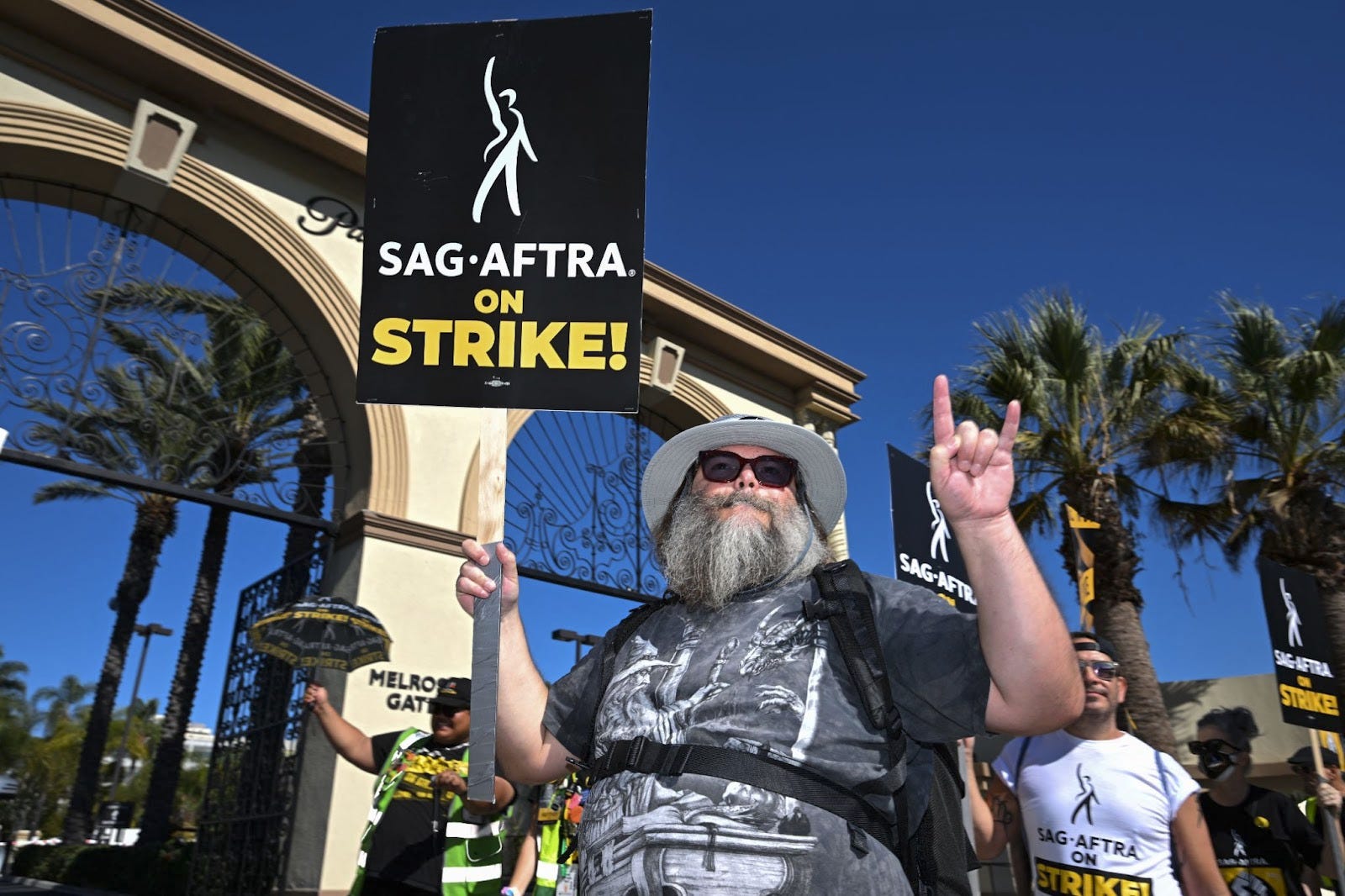
That year, both SAG-AFTRA (the actors union) and WGA (the writers union) went on strike for pay increases, better residual payments for streaming — and AI protections.
Eventually, both strikes mostly succeeded. As a result, actors have control over whether studios create digital replicas of them — and a right to compensation if they do. Studios are not allowed to use generative AI methods to replace writers, nor can they force writers to rewrite AI-generated scripts (rewrites generally earn lower rates than original work). But writers can use AI with company permission.
Union activists have also had some success slowing down the adoption of autonomous vehicles in Democrat-dominated cities like Boston.
However, it’s unclear whether the labor movement can build on these wins to create a unified anti-AI coalition. “One of labor’s great challenges right now” is how to channel AI concerns “into a movement with clearly defined goals and win conditions,” Merchant told me.
There’s also tension between those on the left who believe tech companies are overhyping the pace of AI progress and AI safety advocates who see rapidly advancing capabilities as the main reason to be worried about the technology.
When I asked Merchant about Sanders’s comments around existential risk, he told me that it was “alienating among certain people on the labor left.”
Sanders wants to build a big tent
Despite their differences, there is plenty of overlap between the different groups. Activists pushing against local data centers sometimes mention concerns about the long-term trajectory of the technology. In 2024, SAG-AFTRA endorsed SB 1047, the AI safety bill that was vetoed by Gavin Newsom.
Bernie Sanders’s pivot toward AI safety seems like an attempt to bring these diverse forces together under one banner. With Republicans in charge of Congress and the White House, Sanders’s concrete proposal is unlikely to succeed in the near term; one superforecaster gave the data center moratorium bill a “less than zero” chance of passing.
But his proposal for a national moratorium conditioned on subsequent AI legislation could provide a rallying point for diverse anti-AI forces. If passed, it would give NIMBY activists what they want — a short-term reprieve from data center construction — while also providing leverage for advocates of AI safety, child welfare, labor rights, and other causes.
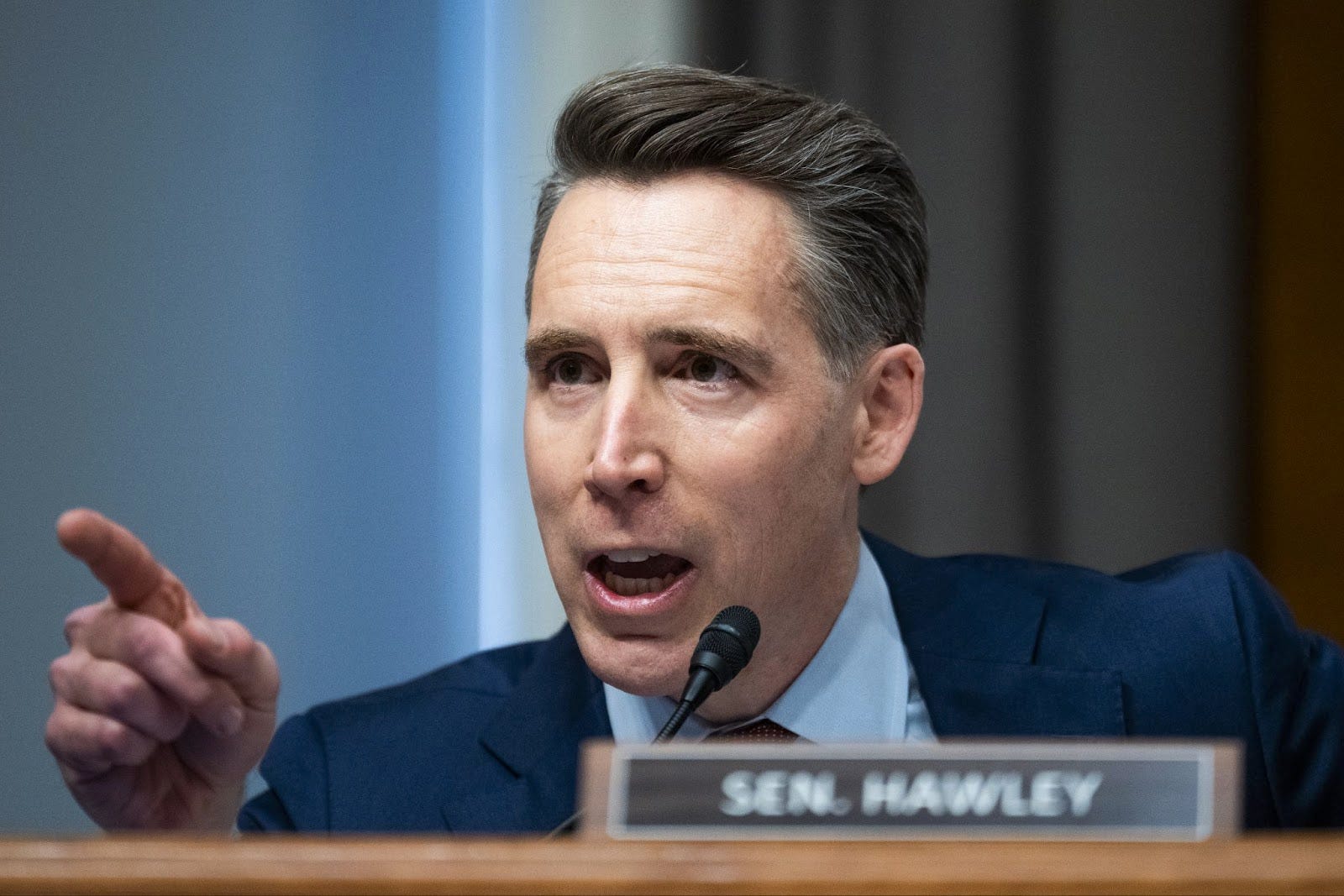
Even some Republicans might get on board. When asked about the moratorium proposal at the Axios AI+ Summit DC, Sen. Josh Hawley (R-MO) replied “What they’re getting at there is the real concern people have.”
Another possibility is that concerns around child safety will lead to more restrictions on AI development.
Protecting children has been a popular AI theme on the right. The first plank of the White House’s proposed AI framework focuses on measures to protect children. Sen. Hawley said at the Axios AI+ Summit DC that “the biggest thing immediately is that we’ve got to focus on child safety.”
But child safety is a bipartisan issue: for instance, the attorneys general of 44 US states endorsed a 2024 bill which would have set up a commission to investigate how to prevent child exploitation using AI.
Perhaps the most powerful speech at the Stop the AI Race protest was from UC Berkeley professor Will Fithian. Fithian was coming from his son Conrad’s sixth birthday party, and he teared up when he mentioned the uncertainty he felt about his son’s future — or whether his son would even survive.
“Every one of you has come out because whether or not Elon cares about our children’s futures, you do. Someday I’ll tell Conrad where I went after his birthday party. And I’ll tell him about the grownups who showed up when it mattered most, to demand his future back.”
Correction: I originally wrote that several speakers in San Francisco mentioned concerns about AIs encouraging teens to commit suicide. It was actually only a couple.
Transformer is published by the Tarbell Center for AI Journalism, which also funds my reporting. The Tarbell Center has had no editorial influence over this or other articles I’ve written for Understanding AI.
Hi Kai, Michaël Trazzi here.
Thanks for your interview and in-depth analysis.
Some comments:
- You argue AI Safety advocates & the left (incl. Bernie) haven't always worked well by default. But Bernie did platform Nate Soares, Eliezer Yudkowsky and Daniel Kokotajlo. Some of them came to our protest, giving speeches, alongside more traditional left people (eg. Sunrise)
- There also seems to be convergence on the instrumental goals: moratoriums on data centers (Bernie, datacenter groups & AI Safety people), OpenAI having less power (AI Safety, QuitGPT, child safety & anti-surveillance people), stopping the race (coalition at this protest). You don't need to agree on why to agree on what.
- You also mention a couple speakers focusing on chatbots encouraging teen suicide instead of focusing on existential risk. But if we can't stop a chatbot from killing a teenager, why would we trust these companies with superintelligence?
- Most importantly, the piece covers the protest in detail but doesn't mention that Anthropic dropped its commitment to pause development (in RSPv3) weeks before we marched on their headquarters, which was in our press release and on our website, and the reason we started at Anthropic.
Overall, I think this piece is good and I wanted to thank you again for asking great questions during your interview, and writing this very important piece: we need more detailed & balanced accounts of AI activism!
I was very glad to read this piece, because it finally talks about the political dimensions of AI. I think the tech sector massively underestimates or simply just does not get the fact that 1. AI is already unpopular and is getting more so 2. In a democracy, you can't sustain a major technological change with most of the people opposed. And they are: 66% say AI needs to slow down according to Ipsos, people are more concerned than excited about AI with a 15 point margin according to Pew. And in qualitative surveys they are saying AI is "soulless". More then three fourths want to regulate it. Unless something changes, one or both presidential candidates are likely to run on anti-AI platform in 2028. And it does not matter that people misunderstand it (of course), or worried about the wrong things.... If you want to propose something smart about AI then yes, you have to have a meaningful coalition. But to stop something you don't need to agree on anything else besides stopping it.... The US is the country that once banned alcohol, btw,